[00:00:15] Speaker A: Welcome to Talkin' Toowoomba, the podcast sharing real stories that matter.
We're proud to partner with Hope Horizons, shining a light on the journeys of locals impacted by cancer and the incredible people who walk beside them every step of the way.
Today's episode is brought to you by Men's Health Physiotherapy, Toowoomba, helping men across our region take charge of their health and well being.
Whether it's recovery after prostate surgery, pelvic floor rehabilitation, or building strength and confidence, again, their experienced team is there to support you every step of the way.
A quick note before we dive in. The content of the Talkin' Toowoomba Podcast is provided for general information and community interest only.
It shouldn't be taken as professional, medical, financial or legal advice and must not be relied upon as such.
Please seek independent, qualified advice relevant to your own circumstances before making any decisions.
Now, let's get into today's conversation.
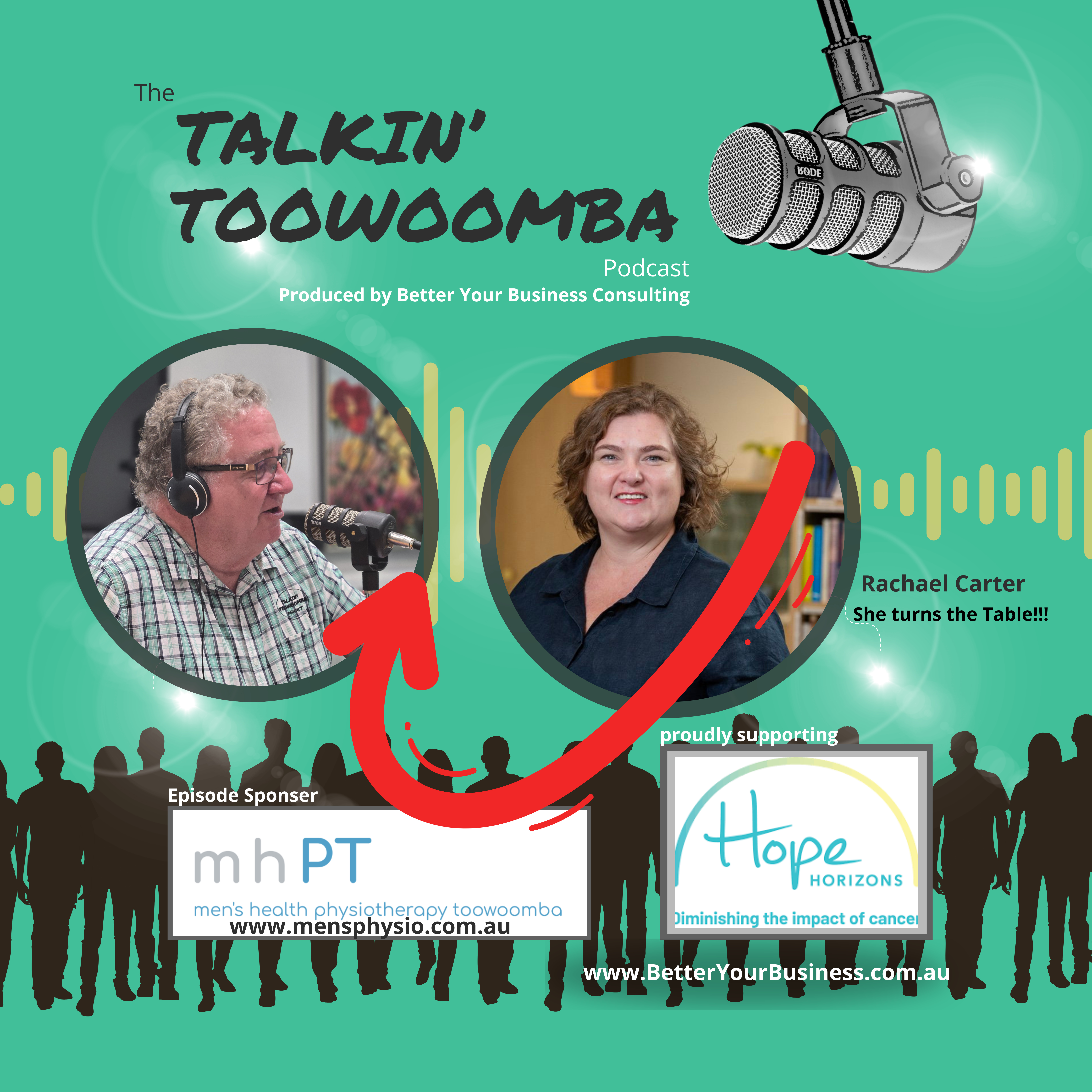
[00:01:26] Speaker B: Welcome to another episode. Today we're chatting with Rachel Carter, who's the general manager here at the Hope Horizons Wellness Center. How are you today, Rachel?
[00:01:35] Speaker C: I'm very well, thank you, Shane. But I am a little concerned about where this conversation is going already.
[00:01:41] Speaker B: Why is that?
[00:01:42] Speaker C: Well, because as we're preparing, you told me to make love to the mic, and this is a PG podcast.
[00:01:48] Speaker B: It is and it will remain as such.
The suggestion of making love to the microphone was for you to talk into and to the microphone.
[00:01:57] Speaker C: Okay.
[00:01:58] Speaker B: So that we capture your dulcet tones.
[00:02:00] Speaker C: I will try my best.
[00:02:02] Speaker B: Well done. Thank you.
[00:02:04] Speaker C: Glad to be here, though.
[00:02:05] Speaker B: I'm pleased to hear that.
So what is it you wanted to chat about today, Rachel?
[00:02:10] Speaker C: Well, today I thought we'd flip the table and I would be the interviewer and you would be the interviewee.
[00:02:19] Speaker B: Oh, okay.
So in other words, what you want to do is you want to put me on the spot instead of me putting you on the spot.
[00:02:28] Speaker C: Exactly. Yes, I do. And I know you have a story to tell. I know you haven't had time to think through these questions, but I think what comes off the top of your head will be just right.
[00:02:40] Speaker B: Fingers crossed that something comes off the top of my head, but let's go then.
[00:02:44] Speaker C: Well, firstly, we know a little bit about you. You know, you do the Talkin' Toowoomba podcast, you're with Better Business Consulting.
But tell us a little bit more about yourself. Where do you live? Who are your favorite people?
[00:02:58] Speaker B: Well, I mean, I've. I've lived here in Toowoomba since about 2012, traveled away for work during that time, but basically, I've lived here in Toowoomba since 2012.
My family roots are here in Toowoomba. My dad was born here in Toowoomba and I can remember as a child coming up quite frequently of a weekend to visit uncles and aunts and cousins here in Toowoomba. So, yeah, Toowoomba's always been a place for me to, to be involved in my favorite people. Well, I mean, obviously there's, there's a partner, Lynette, there's my family. I've got a brother living in England, my sole surviving brother. And of course I've got two beautiful daughters that are living down in Brisbane. But yeah, well, I suppose I didn't include in the list of favorite people is people like yourself that I'm, that I've met through being here in Toowoomba. And that's something that I think is very, very obvious and prominent here in Toowoomba, that once you meet someone, sometimes it might be through a business engagement, sometimes it's just socially.
It's amazing how quickly just a casual meeting ends up developing into like our friendship has developed over the years.
[00:04:16] Speaker C: Yeah, absolutely. We're a friendly bunch most of the time, I think. Yeah. And I think you warrant that Toowoomba right badge. You've been around long enough.
We'll call you a proper Toowoomba. Right.
[00:04:26] Speaker B: Gee, thank you, I appreciate that.
[00:04:28] Speaker C: No worries at all.
One more question about yourself. What would you tell us that most people wouldn't know about you?
[00:04:35] Speaker B: Look, I suppose I'd say it's the fact that I'm willing to give anything a crack. And you know, as you go through life, you have your ups and downs and there's always things that crop up and you've got to try and deal with them the best way you can. And that's what I try to do. And I, for example, a few years back I thought it was a good idea to get involved in doing drone photography and that sort of thing. So I went and studied with casa, the Australian Aviation Safety Authority. And yeah, that was a challenge. That was going back and doing some real, real in depth studies studying aviation law and, you know, looking at what drones can and can't do and that sort of thing. Had to do a written test and a verbal test which was a challenge, but I passed, I got through.
[00:05:25] Speaker C: Good job. Yeah, you've got your license now. We can call you up when we want some drone footage.
[00:05:29] Speaker B: Absolutely, absolutely.
But, and again, someone said to me once, shane, you've got some hidden talents. And I said, yeah, okay. What's that they said your voice and I said my voice. Yeah, your voice is really. I'm sitting.
Let me just. Let me just clarify the fact of my voice. I don't think it's perfect. A lot of people like it. But I do know that I have a face for radio and not for television. Okay, I just. Just want to put that out there.
[00:05:55] Speaker C: You definitely have a lovely voice for radio, but you're very.
It's weird if I say you're pleasant to look at too, isn't it? That's just weird. But anyway, we'll move on from there.
[00:06:04] Speaker B: Thank you. Thank you.
[00:06:05] Speaker C: Ye.
All right, let's move on. Or did you have more to say?
[00:06:09] Speaker B: No, no, let's move on.
[00:06:11] Speaker C: It just got weird, didn't it? And here I was thinking you were making it weird at the beginning.
All right, let's come back to the reason why we're here. Hope Horizons. How did you first hear about Hope Horizons?
[00:06:25] Speaker B: Look, I probably heard about Hope Horizons initially a few years back when Joe Capp was involved in doing some stuff, and I knew of it.
But of course, you sometimes tend. When you hear about places and organizations happening because you don't have a direct involvement with them or you don't have a direct need for them, it sometimes tends to just wash over you.
But then over the last few years, I've had situations where family members and some close friends have gone through cancer journeys, various different types of cancer as well. And it tends to make you sort of think about a little bit more.
And I suppose I'll have to be honest and say what probably really lit the fire to get involved with Hope Horizons like I have is that I myself had a cancer diagnosis.
[00:07:30] Speaker C: Yep.
Can you elaborate on that a little bit? What. What was going on for you when you first walked through these doors?
[00:07:39] Speaker B: Okay. I was first diagnosed with cancer back in late 2021.
Usual thing. Had the blood test, my GP said, oh, yeah, PSA levels are climbing up a little bit. We need to keep an eye on that. You know, could. Could develop into something.
And then later on in. In 2022, yes, they climbed up quite a bit, and I was referred to a urologist for consigning on treatment. And yes, diagnosed with prostate cancer and was looking at the alternative treatments that. That what I had to choose from.
I at the time thought I was being really strong, and I made the decision to have the surgery and have my prostate removed, which obviously meant there could be side effects for me moving forward from that.
But as I said, I remained strong and I Continued forward, had the surgery. And then after the surgery, the prognosis was good. And from about late 2022 until early last year, PSA levels were way down. And I'm thinking, yep, lovely.
We faced a challenge and we've beaten it.
But then the PSA level started to rise again.
Now, is it hard a second time around? Yeah, probably, but not necessarily. And I suppose it was at that point that Hope Horizons.
I don't quite know how, but it came up into my mind again.
And I came here to Hope Horizons, and you were here as the general manager, so it was probably a bit easier for him because. Oh, there's someone I know.
[00:09:36] Speaker C: Yeah. Those doors are hard to walk through sometimes, so having a familiar face inside.
[00:09:41] Speaker B: Yeah.
[00:09:42] Speaker C: Can help.
[00:09:44] Speaker B: So that got me in the door.
[00:09:45] Speaker C: Yeah.
[00:09:47] Speaker B: But I will say without a doubt that I'm damn glad I've walked through those doors.
Cause the support that you get is phenomenal.
And it's not just someone to talk to. It's not just having a place you can go to where you know, you can be safe and talk about how you're feeling, whether you'll be feeling up or whether you're feeling down.
But it's the Allied Health Services that you're able to help people with cancer. Because going through cancer treatment of any kind is not a cheap exercise.
[00:10:29] Speaker C: No, not cheap and not easy.
[00:10:31] Speaker B: Not cheap and not easy. And it does really tax your mental side of things.
But I found enormous amount of support here, and I suppose particularly for me, because I thought I was so big and strong the first time.
This time around, I've realized I'm not. Not as big and strong as I thought I might have been.
But I know I can be with the support I'm getting here at Hope Horizons. And I'm looking at in the next couple of months having to start radiation treatment.
[00:11:11] Speaker C: Yep.
So hopefully we can continue to help you out.
[00:11:15] Speaker B: Hey, I'm sure.
Well, I mean, that's what Hope Horizons is all about, is it? Being that helping hand around what you're doing with your treatment.
[00:11:26] Speaker C: What sort of feelings come up for you when you know that you will need to have further radiation treatment? How does it.
What goes through your mind?
[00:11:40] Speaker B: It's a funny thing, in a way. I say funny, but there are days when you think, yep, it's just another part of the journey.
Then there are other days when you struggle.
And even though you know you're struggling, you know there's help there for you.
And you know you've got to keep going. But it's just.
And you're telling yourself now, come on, be strong, you can do this.
But yeah, it's probably the part that play. It's your mind that I think is probably the biggest problem when it comes to anybody who's going through a cancer journey.
Because there's always, you know, two or three different options for treatment.
Sometimes just a singular treatment, sometimes a combination of a number of treatments.
And you've got to work through that and work through any side effects that come as a result of that.
But it's the, it's funny how the mental side of things can just some days make it even harder than.
[00:12:54] Speaker C: Yep.
[00:12:55] Speaker B: Than it really is.
And you've just got to try and talk to yourself or get some help and talk to other people and push through that. That point of, oh, things aren't so good.
[00:13:13] Speaker C: I want to ask you about the particular services that you may have used here at Hope Horizons, bearing in mind you don't have to say all the services or, you know, but can you tell me about a service that you used and maybe what you expected from that service but then what surprised you as a result of receiving that service?
[00:13:37] Speaker B: Okay. I've basically, I think I've used three of your services here.
I've used the support from a psychologist.
[00:13:47] Speaker C: Yep.
[00:13:48] Speaker B: That helps with your mental.
Sometimes it perhaps doesn't help you as much as you would like it to, but I mean it's there and it is definitely a benefit. And I mean it's not like, oh, we've spoken to you once, that's it, you're on your way. I mean there's always follow ups and that's important and that helps.
There's the oncology massage, for example, in. Actually in an earlier episode we interviewed Rachel Garvin, who was my oncology massager therapist, whatever title I should be giving her. And look, I've had massages before, but an oncology massage is, is quite different.
[00:14:30] Speaker C: Yes.
[00:14:31] Speaker B: And I was amazed at how it helped me cope and feel.
[00:14:39] Speaker C: Yeah.
[00:14:40] Speaker B: And it's, it's something that, you know, when it was first raised and suggested to me, I'm thinking, yeah, massage. Yeah. Okay, massage.
[00:14:50] Speaker C: You sort of think first one to have those thoughts.
[00:14:53] Speaker B: You don't think of it as helping you with what you're going through, but it does, it really does.
And I suppose the other thing from my point of view is I've also had interaction with Corey Pendlebury, who's your physio, who helps men with their pelvic floor exercises.
Now.
[00:15:18] Speaker C: Thanks for sponsoring Corey from Men's health physiotherapy in Toowoomba.
[00:15:24] Speaker B: Yes, Corey, thank you.
One of the things that I found interesting is we're talking about doing the pelvic floor exercises is previously in the first round of my prostate cancer, just before I had the surgery, I was told about having doing pelvic floor exercises and that sort of thing.
[00:15:46] Speaker C: Isn't that a woman's thing, Shane?
[00:15:49] Speaker B: There is.
There's two sides to it. There's a male side and there's a female side.
[00:15:55] Speaker C: Great answer.
[00:15:57] Speaker B: So I'm talking about the male side.
[00:15:59] Speaker C: Yep.
Pelvic floor exercises are not just for women.
[00:16:03] Speaker B: Are not just for women. Definitely not. And the interesting thing was I struggled through that first stage.
I thought I was doing the pelvic floor exercise. Right.
So Shane thought, bom bom.
But when I went and saw Corey, it was very interesting because it's not that I was doing it totally wrong, but I wasn't doing it efficiently is probably the best way I think I can describe it.
And he was able to, through using an ultrasound machine like they use on women for when they're pregnant to see the fetus and like they use in sport physiotherapy to look at damage and that sort of thing in muscles and shoulders and that sort of thing.
Through seeing that I was able watch the ultrasound with him and in explaining to me I could see when I was doing it wrong, how it was not working on the area that I really needed it to work on.
[00:17:07] Speaker C: Yeah.
What a fabulous piece of technology to have.
[00:17:12] Speaker B: Yeah. And look, I mean, if you'd have said to me, if someone had said to me 10 years ago, are you going to sit down with a physiotherapist, you're going to put an ultrasound machine on and he's going to fix you.
You know, how does that work? Would have been my immediate reaction, but after experiencing it. Yeah, it makes a big difference.
Hmm.
[00:17:34] Speaker C: Good one.
Yeah. Thanks for sharing. You know, I think sometimes it's hard to say some of these things and maybe especially more so for men when, when it comes to prostate cancer. And some of the side effects that you can struggle with can be really quite private. And they're things that people don't. Wouldn't usually associate with being a problem for men. So thanks for sharing about that, Shane. I appreciate that.
[00:18:03] Speaker B: You're welcome.
[00:18:06] Speaker C: Is there a moment or an experience here, you know, through your interaction with Hope Horizons that's really stayed with you?
[00:18:17] Speaker B: Oh, wow.
I don't know that it's a single moment, but I think it's.
Without sounding too highbrow and technical, it's the ethos that's here at Hope Horizons.
When you walk through that door, anybody who's here realizes that this person's going on a cancer journey.
And the amount of respect, support, being caring towards you, you're welcome. You don't feel like you're walking into an operating theater, for example. There's no anxiety feeling. It's very relaxing and it's very, very supportive. And I think that's probably the thing that has struck me most since my involvement here with Hope Horizons is the therapists work here and the services that are provided, the reception staff, all the people behind the scenes of Hope Horizons, right through, for example, Hope on a hangar. They're very welcoming, they're very understanding, and you feel like you've known them, even though you might have only just spoken to them once or you're speaking to them for the first time. There's that feeling of, you belong here, you're welcome here.
[00:19:59] Speaker C: I can't tell you how wonderful that is to hear. One of our values is definitely that you're not walking into a clinical environment, but a non clinical environment where, you know, you sort of feel like you're walking into your own home.
So that's wonderful to hear. That's been your experience.
So let me. I just have to check, you know, lean over the microphone and check where I'm up to in my notes. I wanted to ask about your perspective now. You know, before you were with Hope Horizons, from now, has your perspective on wellbeing and support changed since you've experienced Hope Horizons?
[00:20:38] Speaker B: Oh, yeah, most definitely.
It's. I'm trying to think how to sum it up.
It's the fact that you don't have to do it alone.
And there's so much extra that's brought to your attention, whether it be something as far as the treatment's concerned or whether it. Again, I come back to the point of just, you know, being comfortable and having a conversation with someone and then you head off and that's just helped you pick yourself up and go and face the day.
[00:21:14] Speaker C: Great.
You mentioned before that, you know, you, you didn't feel the second time that you got a diagnosis that you were as strong as you were the first time.
Now, I would probably disagree with that. I think, I think it's just another blow. We are very strong. But I wondered what you've learned about yourself since, like, probably especially through the psychological services that you've received, but also, also just your journey in general, what have you learned about yourself along the way?
I told you this wasn't going to be easy. Hey.
[00:21:52] Speaker B: Yeah, yeah, Here you go. Shane, answer this one.
I suppose I can sum it up by explaining it this way.
After the first few months of surgery and the biopsy came back and the blood tests come. Were coming back, it was like hip hip horray done it the second time when they said, oh, we're climbing up again and yes, I'm going to be having some radiation down the track.
It. It sort of was a kick in the guts.
It really was.
I'm willing to say that when I first got told that it's back, yeah, that really, really hit hard and I, I did probably really struggle for a period.
But what being at Hope Horizons has taught me is that if I can relate it to the words of a song and don't ask me the name of the song because I'm never good with names of songs or artists of that sort of thing. But the words in the songs are, I get knocked down, but I get
[00:23:16] Speaker C: up, I get up again.
[00:23:17] Speaker B: Yeah, yeah, no, neither will I. We want people to stay listening to the podcast.
I think that's something that, that I've learned is, yeah, you can get knocked down and it just doesn't have to be with cancer. It doesn't have to be anything medical and just be something personal in your life. It can be with family, it can be, you know, a relationship with a friend or a partner or whatever. You know, something doesn't go right and you get knocked down and you think, right, that's the end of it and you could just spiral downwards.
But if you pick yourself up and get going again, it's amazing how you can come back. And I think that's what's inspired and talking to some people since I've been through Hope Horizons who've gone through the cancer journey and you hear their stories, you think, well, you know, mine's mine.
I mean, I'll share with you. I've got a friend who's recently gone through brain cancer and that's odd, and I think you might know who I'm referring to.
But the one thing that struck me with him was even before there was any word of cancer, he was always a positive person.
Then when he got this diagnosis and we myself ans Lynette, we sat and chatted with him and, you know, it was a pretty serious thing, his being positive about gonna beat this thing. And just seeing him go through the process, it inspires you to think, well, yeah, I've only Got a little bit of problem with prostate. You know, this. This other person's got a problem because I've got brain cancer and. But it. It's just the fact that. Yep.
Head down, tile up and get into it.
[00:25:08] Speaker C: Yeah, good one. And you do have the strength. Right. You just didn't. You were just having a little doubt about yourself. And I think that's very natural. I think that we find that we do.
[00:25:19] Speaker B: I think every.
I would be very surprised if anybody who goes through a cancer journey doesn't have their.
I'll call it a moment. Yeah, it might be one minute, it might be a couple of hours, might be a day where they think, like, all hope is lost. I don't know what to do. They feeling crap, but whether they verbalize it or whether they acknowledge it outwardly or not, everybody's different. Yeah.
Some people tend. You can tell straight away someone's not having a good day.
[00:25:56] Speaker C: Yeah, definitely.
[00:25:58] Speaker B: But other people are able to hide it better.
Don't know that I was a. I'm able to hide it all that well.
[00:26:05] Speaker C: You do tend to wear your heart on your sleeve. But that's what we love about you, Shane.
[00:26:08] Speaker B: Yeah, it's funny. It's funny. That was exactly what I was about to say. I was once told many years ago that my, My problem. I was told my proglem. Shane, your problem is that you wear your heart on your sleeve.
But then again, I don't see that as a problem.
[00:26:27] Speaker C: Definitely not.
[00:26:28] Speaker B: I see that is. Well, at least the person knows who they're talking to, what they're going through or, you know, what they're feeling. And okay, he's been up front. He's not hiding anything. Maybe I should hide things sometimes. But anyhow, we'll go from there.
[00:26:47] Speaker C: I think that message in society about being too emotional or it might be changing a little bit. You know, we do. We do definitely need to share those feelings and emotions a little bit. How are we going for time? Because I've got a couple more questions here.
[00:27:00] Speaker B: Well, we're going to get into perhaps one of the longest episodes, but. Go.
You got a couple more questions?
[00:27:05] Speaker C: Yeah, I do.
What does hope look like for you now as you move forward in your cancer journey, knowing that you've got radiation ahead, but also knowing you've got a community supporting you?
[00:27:20] Speaker B: I suppose. I mean, I'm.
I'm looking forward knowing that I haven't quite 100% beaten it yet, but I'm well on the way. Yeah, I've. I've got a plan as far as My treatment is concerned.
I've got a plan because I've got hyperizons walking alongside me and saying, if you need anything, we're here.
And I know that and, and that that's helpful. So I suppose my outlook is, is pretty optimistic because I know that I've got treatment in place, planned out, and I've got Hope Horizons walking alongside me, ready to help me if I need it.
[00:28:08] Speaker C: Good one.
So we'll move away from you a little bit.
Toowoomba rallies around organisations like us, really, really well around good causes.
As a business owner in Toowoomba, what does that community support look like from your side of the desk? You know, what role do those partnerships have in sustaining charities and good causes like Hope Horizons?
[00:28:39] Speaker B: Look, in this day and age, there are so many charities around and covering such a huge gamut of reasons why the charity exists, but I suppose the one thing, I mean, I've made donations to charities over the years.
I've supported the Flying doctors, for example, I've supported Red Cross. And yes, it does make you feel good to do that sort of thing, but I know it's tough on businesses to be always putting their hands in their pockets.
But as I see it, cancer is very unique because it doesn't discriminate, it isn't always kind and sometimes it's not a case of, you've got cancer X, take this treatment, do this treatment, three months down the track, done and dusted.
Cancer's not always like that. There are stories like that and they're great stories and these stories that help motivate anybody going through a cancer journey to pull on those sort of stories and get encouragement.
But it's the fact that it, it doesn't always play fair that makes me think businesses need to think about trying to support Hope Horizons as much as they can.
And, you know, through, through some of the interviews we've done and talking about what Hope Horizons does, it, it is clear to me that this is not just a charity to fill a gap.
It's not just a charity to be doing something nice.
Hope Horizons has a dramatic effect and change and support for people going through cancer.
And if anybody's out there thinking, oh, I've got a few bucks to spare and it doesn't have to be a million dollars either.
[00:31:06] Speaker C: Definitely not. I mean, although that'd be nice. Sure, if you want, absolutely.
[00:31:12] Speaker B: But I mean, every, every dollar helps because it's these services that you provide that are paid for, for people like myself going through the journey that can't always necessarily afford to have all the extra support. They're on a budget and they can only go a certain way. But this is extra help here that Hyperizons provide and it's very important.
And I'm gonna shamelessly do a little plug.
If you're listening to the podcast, if you're a private individual, there's a link on the podcast where you can make a donation, whether it be $5 upwards, whatever amount you're comfortable with.
70% of that donation comes to Hope Horizons.
[00:32:05] Speaker C: Beautiful.
[00:32:06] Speaker B: I just take the little bit off to help fund the podcast, keep it going.
For businesses who are interested. We've got promotional packages available where a business can then come on as a sponsor, like Men's Health Physiotherapy has. So thanks to Corey for doing that.
They get some benefit from it. They get to tell their story about what their business does in Toowoomba. They also get to be acknowledged the fact that they're helping Hope Horizons.
And again, 70% of their sponsorship packages straight through to Hope Horizons.
So we see it as a way. And that's sort of why I reinvigorated the podcast Talkin' to Toowoomba was to try and help Hyperizers. I was trying to give back to Hyperizons more than I can afford out of my own pocket.
So if anybody's out there that has got a few dollars to spare or a business wants to do some promoting in themselves, but know that they're actually helping the Toowoomba community and Hope Horizons, get in touch.
[00:33:13] Speaker C: We're very grateful for your support. Thank you, Shane. And to Lynette as well.
So in wrapping up.
Yes, Hope Horizons is celebrating our 10 year anniversary this year. So we've been incorporated since 2016 about in March and we're celebrating and one of our celebrations is the Sapphire Soiree happening in June.
[00:33:37] Speaker B: Yes, I know about this. Yes.
[00:33:39] Speaker C: And it will literally be our Runway on the Runway. What's your. What role are you playing at the Sapphire Soiree, Shane?
[00:33:51] Speaker B: I certainly won't be doing a podcast episode from there, I don't think.
Yes, you've approached me and I've agreed in a moment of weakness maybe that I agreed to be part of this Sapphire Soiree. And I might just get you to sort of explain because you'll do it better than I will what I'm letting myself in for.
[00:34:16] Speaker C: Yes, we're going to show his pretty face.
Yeah.
Not stick with radio, but yeah, we're really excited to actually celebrate some of the impact that we've had on our clients over the last 10 years since we incorporated. And so a fair bunch of our clients will be running the Runway, sharing their story, and we'll be able to be celebrating them and the impact that we've had over the last 10 years. So thanks for jumping on board with that as well.
He'll be dressed up to the nines and swinging those hips.
[00:34:47] Speaker B: Swinging those hips wow . Look out.
[00:34:49] Speaker C: We're really looking forward to it. So keep your eye out for that one. For the tickets coming on sale.
[00:34:56] Speaker B: And I just want to mention.
[00:34:57] Speaker C: Yeah.
[00:34:58] Speaker B: In wrapping up. Yeah. That at the moment there's a raffle.
[00:35:03] Speaker C: Oh, yes. Yep.
[00:35:05] Speaker B: Now, the raffle is an absolute cracker. Cracker.
[00:35:12] Speaker C: Yep.
[00:35:13] Speaker B: Yep.
Because it's only $10 a ticket.
[00:35:16] Speaker C: Yep. Thanks to Harvey Black Group. What have we got as the prize?
[00:35:20] Speaker B: You have as the prize a Havel H6 hybrid car valued at $41,000 that
[00:35:30] Speaker C: just rolled off your tongue. I don't think I can say all that.
[00:35:33] Speaker B: There you go.
[00:35:33] Speaker C: Good job. I knew I brought you along for a reason.
[00:35:36] Speaker B: There you go. So, look, there's another way that you can help.
[00:35:38] Speaker C: Yeah.
[00:35:39] Speaker B: Hope Horizons.
[00:35:40] Speaker C: And it'll pop up at other events around town, too.
[00:35:42] Speaker B: So. Yeah. So it's a great opportunity to. To help Hope Horizons. And you could be lucky enough to pick up a new car.
[00:35:50] Speaker C: Yeah. Nice. Very exciting.
Well, thank you for letting me flip the table today, Shane.
[00:35:56] Speaker B: Yeah, right. I'll make it. I'm making a note of this. I'll get back at you somehow.
[00:36:00] Speaker C: Let's flip back, though.
Yeah. Thank you so much for sharing your story and what Hope Horizons and has meant to you means a lot. And your support means a lot as well. So thanks so much.
[00:36:10] Speaker B: Thanks, Rachel. Have a great day.
[00:36:12] Speaker C: You too. Bye.
[00:36:19] Speaker A: Thanks for joining us on Talkin' Toowoomba. If today's episode inspired you, please share it to help spread hope and connection right across our community.
A special thanks to our sponsor, Men's Health Physiotherapy Toowoomba, for supporting this episode and the important work of Men's Health in our region.
And as always, a big thank you to Hope Horizons for their incredible contribution to local families living with cancer.
The content of Talking Toowoomba podcast is provided for general information and community interest only.
It should not be taken as professional, medical, financial or legal advice and must not be relied upon as such.
Please seek qualified advice relevant to your own circumstances before making any decisions.
Until next time, keep talking Toowoomba.
LINK TO HOPE HORIZONS WEBSITE: https://www.hopehorizons.com.au/
VISIT WEBSITE CLICK ON
https://talkin-toowoomba.castos.com/
TO CONTACT US
[email protected]
TO DONATE CLICK ON THE LINK
https://talkin-toowoomba.castos.com/donate