Episode Transcript
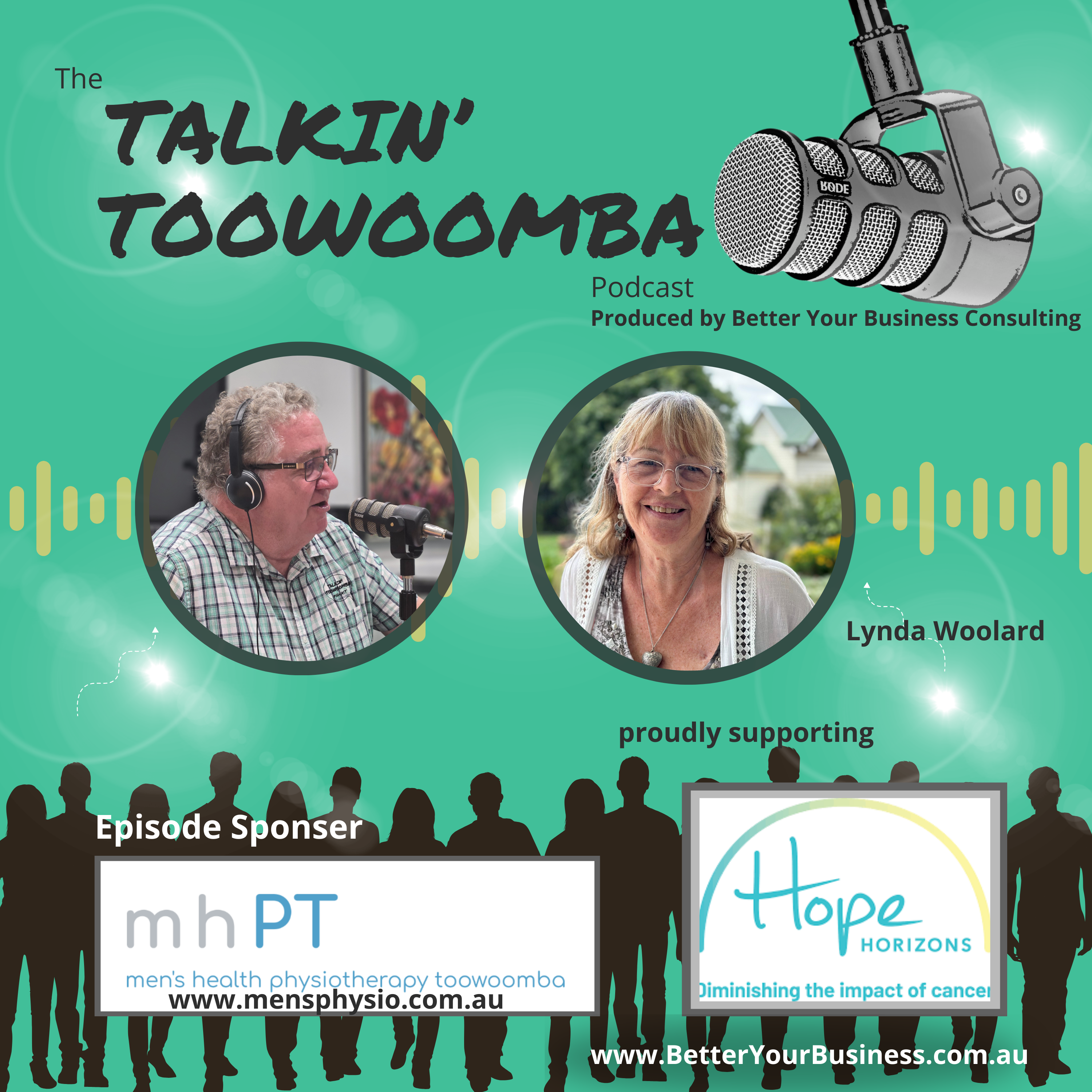
[00:00:15] Speaker A: Welcome to Talkin Toowoomba, the podcast sharing real stories that matter.
We're proud to partner with Hope Horizons, shining a light on the journeys of locals impacted by cancer and the incredible people who walk beside them every step of the way.
Today's episode is brought to you by Men's Health Physiotherapy, Toowoomba, helping men across our region take charge of their health and well being.
Whether it's recovery after prostate surgery, pelvic floor rehabilitation, or building strength and confidence, again, their experienced team is there to support you every step of the way.
A quick note before we dive in. The content of the Talkin on Toowoomba podcast is provided for general information and community interest only.
It shouldn't be taken as professional, medical, financial or legal advice and must not be relied upon as such.
Please seek independent, qualified advice relevant to your own circumstances before making any decisions.
Now, let's get into today's conversation.
[00:01:24] Speaker B: In today's episode of the Talkin Toowoomba podcast, we're going to be chatting with another person who's been through the cancer journey. I'm chatting today with Lynda. Lynda, welcome to the podcast.
[00:01:35] Speaker C: Good morning, Shane.
[00:01:37] Speaker B: Now, Lynda, you've been through a bit of a journey with cancer and whilst I don't know a lot about your journey, we had a little brief chat just before we started recording this and I think it's a very interesting story.
Do you want to take us back to the beginning?
[00:01:55] Speaker C: Sure.
So I'm typically one of those people who believes in natural therapy and I believe in natural healing and I was self diagnosing for four years.
I was tired, my body odour had changed, so I self diagnose it. Maybe I had irritable bowel syndrome or maybe I had Crohn's disease. I could google my symptoms and everything would come up. So took myself off to my health food shops and my nutritionist and I set myself up to fix myself and at the same time I was working seven days a week or mentally seven days a week. So my life was very busy and I didn't really have time to really look at what was going on because I thought I knew what was happening.
It wasn't until four years after I had an incident where I had what was they diagnosed as a pinched nerve. But what it was, it was a cancer starting to grow on my nerves, my sciatic nerve, which sits at the bottom of my spine.
So it had four years of growth before I finally took myself off to a gp.
[00:03:10] Speaker B: Wow.
I'm assuming at that stage that the cancer tumor for want a better term itself was quite large.
[00:03:21] Speaker C: It was huge. It was 8.5cm and it was a solid ball.
[00:03:27] Speaker B: 8.5cm and a solid ball sitting in my rectum.
How did you first feel when that was said to you?
[00:03:38] Speaker C: Look, it was like water off a duck's back to me. I took the information on board and then I just jumped onto a roller coaster with some of the most amazing, smart and compassionate people I've ever met in my entire life.
Through this whole journey, I haven't cried, I haven't got upset.
I went straight into manage mode and went into setting up my life with cancer and what was best for me. I suppose
[00:04:15] Speaker B: you said that you didn't cry. You sort of went into, I suppose, criss management mode.
Is that how you describe it?
[00:04:24] Speaker C: No.
I could start a whole other podcast on my childhood. I grew up in a Catholic family, a big Catholic family, and we went to church every Sunday. I had 25 cousins.
I had the most amazing aunties. These are old Australia people that struggle. We lost our grandfather to the war, and my grandmother brought up all my auntie uncles by herself.
So I had a very big growing up in Catholic religion and I suppose and I just put my trust in my faith, even though I hadn't been to church since I was 18.
It just kicked in.
[00:05:08] Speaker B: Okay, so you've been told you've got this cancerous tumor just over 8cm in size.
What was next part of the journey? What did you do next?
[00:05:23] Speaker C: So the next thing was I watched my surgeon make a phone call.
And from that phone call, he turned around to me and he said, okay, this is what's going to happen.
Even though I did have a choice.
But they were very, very good. There was about seven of them in the room, including my partner and myself.
And they drew a picture of where the cancer was.
They said to me, what we're going to do with you, you either go into palliative care or we can do this. We can give you a stoma now.
We're going to put you in tonight. Hope you've packed a bag. We're going to give you a stoma. I have no idea what a stoma was. And I'm going, yep, yep. And he said, Then we're going to give you some chemotherapy, then we're going to give you some radiation, and then we're going to send you off to Brisbane, the Royal Brisbane Hospital, and they're going to operate and take the cancer out.
And I was like, okay.
So I just trusted Them.
And so my first thoughts were, I have so many animals at home.
My partner works full time, he runs his own business. So my very first thoughts were with organizing at home and getting some help at home for my partner and myself because we live on a big 70 acre property. Six horses, six dogs, 30 peacocks, heaps of children, two goats.
[00:06:48] Speaker B: An extended family, Huge extended.
[00:06:50] Speaker C: Neither of us have children or actually, sorry, I don't have children, but we don't have children around us. So yeah, we. We live with fairy animals. So that was my very first concern was my partner and my animal.
What's going to happen here? But I have a huge family. They all live in Melbourne, but you know, it's just a phone call away, all that sort of thing. So, yeah, I can't say I had any terrifying thoughts the whole way through. From day one, I've thought I was going to be okay and I still do think I'm going to be okay.
So, yeah, like it just gets me through you.
[00:07:29] Speaker B: Are you chatting with me now?
Okay, so you went through some radio, you had some chemotherapy.
[00:07:37] Speaker C: Yeah.
[00:07:38] Speaker B: And then you went in to have the surgery.
[00:07:41] Speaker C: Yeah.
[00:07:42] Speaker B: Now I understand. The surgery was horrific and something I was going to say, the only word I. The only word that sprung to my mind was invasive.
[00:07:54] Speaker C: It's probably the worst if you're going to have surgery. Well, I shouldn't say the worst of. Because everybody's time with hospitals is different. But I've always done things. Well, if you're going to do it, do it properly. So, yes, it was a surgery where they had to remove my rectum, which means I had to have my stoma full time.
And then my bladder was damaged.
And we were never sure how my bladder got damaged, but it had a mark on it from either the radiation or the cancer itself was moving in. At the time, we didn't know. My MRI scan was perfect because I meditated through the whole thing.
Sorry, my pec scan. So it gave a really clear picture. But when they actually opened me up, my whole pelvis was full of cancer and I was still walking around like a normal everyday person, feeding horses, going shopping. I got a great job with the best company I've ever worked for.
Yeah, I was working part time, but full time because I kept saying, yeah, I'll do it.
Yes. So the only thing that was I was being robbed of was energy. I found I was tired.
Yeah, more tired than normal. But I'd still do things even though I was tired, which is not a good thing to do when you're that sick. So, yeah, I was too busy to see the warning signs.
[00:09:23] Speaker B: Yep.
So this surgery, and as always with anybody that we chat to about their cancer journey, we do respect their privacy. So you can tell us as much or as little as you want. Yeah, but what.
How has the surgery changed you? Let's say for the moment, let's talk about physically.
[00:09:49] Speaker C: So I lost my S1 nerve on my left leg, which is my sciatic nerve.
And I'm a walker. I walk every day, every night.
Used to be a runner. So for me to not be able to use a leg was devastating.
So my whole focus, from the second I woke up, I actually made my nurses get me up and walk me to the end of the ward so I could see if my leg was working, because they told me it might not.
So my whole focus has been on my leg.
So anything else that's come with it. I went through horrific pain when I got home from hospital.
I got removed from hospital because I was dancing in a ward with another patient and we were singing songs.
[00:10:37] Speaker B: In other words, you were expelled. Is that what you tried to cover up? You were a naughty girl and you got expelled.
[00:10:43] Speaker C: One of my surgeons, and I hesitate to say their names because I haven't checked with them about saying their names, but I'll never forget him. And he's probably the most unassuming surgeon of all. He's a young fellow, but he walked past the room in the middle of the day and just looked at me and pointed at me and said, you are so going home on Monday. We are holding you up in here.
And that was after 17 days. I should have been there for 30 or 60.
[00:11:16] Speaker B: That's the crazy and a side of the person inside you, isn't it?
[00:11:22] Speaker C: I was determined to walk.
[00:11:24] Speaker B: Yeah.
[00:11:24] Speaker C: And everything else was. Didn't care. Yes, I had bags. Yep, yep. I can do them. But where's my physio lady? I want to walk. I want to walk. I want to walk.
It took me a year and a half to walk, probably.
And even now, it's not perfect, but only I know that.
[00:11:43] Speaker B: Well, I saw you walk in here, and I didn't pick anything.
[00:11:45] Speaker C: No, I can feel it. Because when you. I've had my whole pelvis removed, which means I've lost bowels.
I've lost my appendix. The cancer was hiding in my appendix.
I've lost my bladder.
All my bits and pieces that go with going to the toilet have basically been taken off me because of the cancer. It was just in there. It was. Right.
So when You've had your pelvis removed. You think, what goes there?
[00:12:16] Speaker B: Yeah.
[00:12:17] Speaker C: So they do a lot of work in making sure. Well, all your. The first question my partner asked was, are the rest of her organs going to fall down?
And they said, no, there's lots of muscles and things and nerds and things that hold them up. So that's never a thing.
And my pelvis will grow. Like, it will fill.
It'll just be the skin and there's a lot of scar tissue down there.
So when I came home from hospital, a girlfriend of mine moved in and another girlfriend of mine moved into our caravan in Annex. One took over the looking after of all the animals and the other took over the feeding of me because I'm a bad eater. And the most important thing was to get my bowels moving and running.
[00:13:04] Speaker B: So you're like me.
You enjoy the stuff that you shouldn't enjoy and are a bit laxy daisy about eating the.
[00:13:12] Speaker C: Absolutely.
[00:13:14] Speaker B: But it's what you have to do, isn't it?
[00:13:18] Speaker C: Yes. Yeah. So it's really, I suppose, surreal to say my whole pelvis has been removed.
[00:13:29] Speaker B: Yeah. I'm sitting here listening.
[00:13:33] Speaker C: It's not that bad.
Yeah.
[00:13:35] Speaker B: Okay.
[00:13:36] Speaker C: It's not that bad.
[00:13:38] Speaker B: It's okay. So I just want to reiterate.
Lynda's saying it's not that bad.
It's hard to get your head around. But if Lynda says it's not that bad and she's sitting here in front of me, really.
So if anybody is ever in a similar situation or faced with, you know, this sort of scenario, know that it's not that bad, you can.
You can get through this.
Sorry, Lynda.
[00:14:09] Speaker C: No, but that. That's the whole thing. It's like it was bad.
It only became bad when they removed it.
[00:14:19] Speaker B: Yeah.
[00:14:19] Speaker C: Before that, I was like this little. This little superstar because I was so fit and healthy. I'm 66 in August, so I was so fit and healthy because I'm a walker and I'm always moving. And I was doing everything they told me to do.
My attitude was there. I had this beautiful. And I will name her Bianca. Had this beautiful little doctor, and I probably shouldn't call her a little doctor. Beautiful Singaporean girl, I think she was.
She came to me three days after my operation in Toowoomba Hospital, and she said to me, Lynda, do not take. No more endones, no more Panadol. I want to talk to you. I want you to hear me.
Okay.
I didn't sleep at all that night.
She wanted to see where my body was. And how my pain was. And you can't tell when you. And when. You'd never taken pills like that before. Being a health nut, they really affect you. And I was knocked out. I was having the best time ever in hospital.
[00:15:30] Speaker A: Legally.
[00:15:30] Speaker B: You want to land, that's legally chatting
[00:15:32] Speaker C: to everybody, walking around, helping people. Do you want a drink? Do you want this? Do you want that? Yes. Anyway, she came in next morning because I could hear a little he go, click, click, click. And then she come, she grabbed my hand. She goes, okay, I need for you to move, move, move.
I need you to eat, eat, eat.
And I need you to keep that positive attitude. Do not let anyone take it from you. You keep it because it's going to get you through.
And she was so right.
She was so, so right. And two years later, I got to meet her boss and we were talking and I said to him, you know, he said, you're doing really well, you know, like, your attitude, everything. And I said, I was set up to win by Bianca.
And he said her last name, and I said, yes. And he said, I've trained her. And she listened.
So it was like a big circle came round. And when I realized that he'd trained her and here I was with him, I was happy as I really was.
[00:16:39] Speaker B: Okay, so how long were you at home with these two girlfriends of yours helping you out around the property?
How long was it before you were able to start doing things more for yourself?
[00:16:56] Speaker C: It wasn't until I came here to Hope Horizon.
I heard of them through my cancer care nurse. I have to say, Medicare has been fantastic and Toowoomba Base Hospital have given me the most beautiful people into my life now that I keep forever. And I've got two cancer care nurses. And one of them said to me, she gave me the Hope brochure, and I came over here and I spoke to the beautiful ladies, the volunteers at the front counter.
[00:17:27] Speaker B: Now, I'm sort of going to ask a question that sort of may put words into your mouth, but I'm hoping it doesn't. And I hope you can answer it from your heart.
Did you feel when you first walked through the door here at Hope Provide, how did you feel? And did you feel like almost instantly, this is where I need, this is where I belong?
[00:17:56] Speaker C: Yep, absolutely.
It was somewhere. It's funny when you're invited into the hospital, into the hospital system, you get all these teams of people and they help you run your life, not as in running your life personally, but with your tablet and what you should do and what you shouldn't do. And they have all the information for you when they say to you, it's time to go home now.
You go home and you've got nobody.
They are at the end of a telephone, but they're no longer running around your hospital bed and fasting over you and giving you your tablets while you're coloring in and talking to other patients and listening to podcasts. You know, they just walk in with a little cup here, take your tablets and you take them. So you feel good in hospital and you feel better, but when you get home and they're not there to run that part of life for you, it's a big learning curve. And I think for me, that was the most horrific thing of all, was getting home and learning to take my medication because I was so anti medication.
I put myself through a lot of suffering and pain until the girls just went, look, we're taking over now.
And my husband, he's just gone. Nah, no, no, you are no longer in charge.
We're in charge now. And, yeah, I let go a little bit. And yes, we got through a lot, started managing the tablet and the pain. I got onto some medicinal cannabis, which took my nausea away. And that was my big, biggest thing. I could not think, I could not do anything. My temper was short, which I'd never had before. Nobody could do anything right except for my two little animals and my outside dogs I couldn't get to. And they're standing at the window crying.
All my animals can come near my room. Circle horses. Everyone's staring into my room at one stage. And that was the worst, worst time of my life. The pain, the nausea, the everything.
And then they introduced the medicinal to me with help from my cancer care nurse. But they can't help you too much.
And that changed everything.
That changed the nausea. And once I got rid of the nausea out of my stomach, that was it. I could come here. And that's the first thing I did, was got Maria to drive me here. And I walked in, I spoke to the ladies, and I just felt like, yay.
It was new. Everyone was smiling.
It wasn't sad.
And it was different. It was a little bit like hospital again, but in a different way.
[00:20:42] Speaker B: In a different way.
[00:20:43] Speaker C: Yeah.
[00:20:44] Speaker B: It didn't feel like you were in hospital.
[00:20:46] Speaker C: No.
[00:20:46] Speaker B: But you.
[00:20:47] Speaker C: I felt safe.
[00:20:48] Speaker B: You felt safe.
[00:20:49] Speaker C: That was it. Yeah, that was it. Because my surgeon said to me, look at you in hospital. So I feel safe here.
[00:20:56] Speaker B: Yeah.
So let's, let's. Coming up to the present day.
[00:21:04] Speaker C: Yep.
[00:21:05] Speaker B: No doubt we could talk Quite a bit more on all of the things you've gone through since your surgery and we'll call it your rehab. At the point you're at now, how do you feel now and what do you see for you?
Trying to think how to put it, what you're going to be looking to achieve into the future.
[00:21:32] Speaker C: That something.
The future question, I think about all the time, but I haven't really hit what I'm going to do. There's lots of little ideas in my head, but I haven't really.
It's strange or. I was talking to Dave this morning. We were saying that I have lost my excitement on things.
100% lost my excitement on things. I should have been so excited coming here this morning, but it wasn't.
[00:22:01] Speaker B: People think I'm scary.
They get to the door, they see, they go, it's not that bad.
[00:22:07] Speaker C: Yeah. And like, just little things like Maria will say, let's go up to Grand Central and go through the shops. I'm like, you know, I love window shopping. So I've lost that.
Something's lost inside of me and I call it the passion. I've lost the passion because the passion's internal fixing everything I've learnt.
Stop trying to run ahead of this thing.
My body's controlling me so I don't know what I'm going to do because it hasn't finished controlling me and I haven't finished healing it. So we're still on that journey. Which brings us back to here, where I was walking on a wheelie walker when I walked in here and they offered acupuncture, which I'm terrified of, and I. Oh, I've got to do it. I've got to. I wanted to try everything. I really wanted the reflexology with Di, so I got that and then I met John and he's amazing.
And John got me onto acupuncture, which I hate, but it works and it's got my leg working.
[00:23:15] Speaker B: Okay.
Roughly how many treatments of acupuncture have you had?
[00:23:20] Speaker C: I think I'm about seven now.
[00:23:22] Speaker B: Okay.
Are you still. Do you still get terrified, you know, easy feeling when you go for a treatment now after you've had seven?
[00:23:32] Speaker C: Yeah, that's okay.
[00:23:35] Speaker B: That's okay.
And I think that's. That's quite normal. But you also realize that it's working, it worked. And so you're also well on.
You gotta have it.
[00:23:47] Speaker C: Yeah. And also John's so full of knowledge, so I've picked up more knowledge from knowing him, which I got through here, which has Been great because I've met many people like John along the way, which have given me the tools to set me up to win. I call them tools corporate. But they have been so honest with me and told me what's happening to me, whether it's been good or bad. And I've always said to them, good, now I can deal with that. And then I go away and I deal with it. I use my natural therapies now all the time, which has got them in absolute awe. And now they've started to write down what I'm doing because out of the. I think it's six of us were six training operations. I'm not sure the number.
I'm down towards the end, but I'm doing extremely well. Every time I go and see them, I want to stop and chat for hours and they're like, go home. Yeah, we can do this by phone. And I'm like, no, I want to go face to face because I always have a list of questions. They answer them, they'll go home and sort out.
[00:24:54] Speaker B: And I think you've just raised a very important point which I think we need to highlight. And I know from my own experience I. I was to blame.
When I was first diagnosed, I probably didn't ask as many questions as I should have.
I did decide on what treatment I was going to have. I don't regret the path that I've taken and I don't regret where I'm going in the future.
But I do know it's important that you talk to the.
The surgeons, the specialists that are caring for you. It's important that you communicate with them and gleam as much information from them as you can.
Because I think if we and males are probably notorious for it, we'll be right, mate. We'll stick our head in the sand and we won't worry about it.
[00:25:52] Speaker C: I was one of them.
[00:25:55] Speaker B: But it's amazing when you let that barrier down and ask questions and let the information flow how much it can help and it gives you things to do or treatments to take on board that are allied to what you treatment. Like all these different allied health services that are available through Hope Horizons, sometimes when they're suggested to you with you. I don't really want acupuncturist but in having helps you far beyond what you thought it would.
[00:26:38] Speaker C: That's right. And having John being the one who's giving the acupuncture, he's an amazing man that's had an amazing life and he has amazing care for people.
So if it was anybody else, I probably wouldn't come back. But he made it so easy.
[00:26:57] Speaker B: So you've developed a real rapport with John.
[00:26:59] Speaker C: Absolutely. Absolutely. He was just a very caring, amazing individual.
[00:27:04] Speaker A: Yeah.
[00:27:04] Speaker B: I haven't had acupuncture, but I've had other treatments through here, through Hope Horizons. And it's exactly the same.
The people that are here giving you the particular treatment, whether it be acupuncture, whether it be a massage, whether it's doing physiotherapy or any other allied health treatments. The people who are here with Hope Horizons have a definite passion.
[00:27:33] Speaker C: Absolutely.
[00:27:34] Speaker B: And they're really invested in you individually, aren't they?
[00:27:38] Speaker C: Yeah. As soon as you walk in the door. So I've been in and out of here quite a lot now. I think I'm probably coming up to over a year that I've been in here.
And I've seen them busy and I've seen them busy, busy, busy. And someone walks in the door and they stop. Hi, how are you? They stop and acknowledge. No one runs around here and doesn't acknowledge a person when they walk past them or see them or would you like a drink of water or, you know, there's tea and coffee over there. Like, they're very aware of you when you walk in the door. So, yes, it's a place where I would suggest for anybody, just come here. I did Tree of Life with Deb, and as another lady, Phyllis and I were in there, and Tree of Life is amazing. And I don't want to spoil it for anybody, but anybody who comes to Hope and does Tree of Life with Deb, it just opens up your mind.
Anything that was locked inside, it releases out, and it's just talking and drawing is the best thing. That was something. Meditation helped me tremendously with my pain, and I had never really done meditation before, and it was. She just taught me how to breathe, which I thought I knew how to do, but she taught me a different way, how to breathe and breathe through my pain. That helped me immensely. I have to say, for the times when I was still getting pain in my leg, I applied the meditation to it. They have yoga.
I haven't been able to sit on the floor, so I haven't done yoga yet, but I am going to.
[00:29:13] Speaker B: And I don't doubt that you feel one little bit.
[00:29:17] Speaker C: I'm going to have a crack at yoga because my pelvis is not the same anymore.
[00:29:23] Speaker B: Yeah.
[00:29:24] Speaker C: I have to be cleared by my beautiful physio, Sarah, up there at Toowoomba.
She knows I Want to do it. So my last thing with her, she'll probably clear me and then I can do yoga. But that's not all here.
[00:29:37] Speaker B: No. There's so many different services that are
[00:29:40] Speaker C: available, you need hours to talk about it. But it's an easy in. Go to your GP and they just give you a letter and I think it's just basically saying you are sick.
[00:29:52] Speaker B: Yep.
[00:29:52] Speaker C: And it's a health plan and you come in and then they just do everything from there and you have a look at what's available.
[00:29:58] Speaker B: And so, look, I think in summing up, we didn't get into all the gory detail, which is probably a good thing, but we realized you've been through a very tough cancer journey as far as the cancer itself and the treatment, but you've bounced back and you found a place where you can continue to hear help and support, which is here at Hope Horizons.
And beauty of it is, if you go about it the right way, you get the health care plan from your gp, you bring that through here to Hope Horizons, basically. Then there's so many services that you get access to a lot of it at no cost to you. And it helps you on your journey, doesn't it?
[00:30:47] Speaker A: Yeah.
[00:30:50] Speaker C: Yep. Absolutely. And it's just when you come here, the building is very nice and it's very comfortable, so you've got comfortable places to sit and there's so many little, not little. There's so many rooms and spaces here that you can move anywhere. There's beautiful garden outside. So sometimes when you have cancer, you have times where suddenly you feel sick.
Here's a space where you can feel sick and still feel safe.
[00:31:18] Speaker B: And it's not just a question that you maybe feel physically sick, which you can do, and you get the support here. But even if you're just feeling a bit on the downside and you know you're struggling a little bit mentally with it, all the support is here at Hope Horizons for you, for that sort of thing as well.
[00:31:36] Speaker C: That's it. And, like, when you do lose everything in your pelvis, you're never better. There's always something. There's always scar tissue.
There's always. It's sitting right at the top of your legs. So there's always going to be pains in your legs. Sometimes you get pains in your thumbs, your fingers.
I can't feel most of the left side of my body, so a lot of times I'll sit down and there's nothing there, but I feel like there's a big rock there. So I Can't sit on hard surfaces so there's a lot of things that are always rumbling in there so you never 100% better but here is a place where you can come and get some reflexology and that might make it for that time, that part. Or you come and get your acupuncture of John and that fixes it for a while or you've got all these services here. I can come to meditation if I'm sort of things aren't going good and I need some meditation. I keep getting kidney infections so coming here with all these services and my natural therapies I've only had two so I'm doing well and they do bring you down pretty badly.
[00:32:49] Speaker B: I can will. I've urged you.
[00:32:50] Speaker C: It's shocking.
[00:32:52] Speaker B: Lynda, I want to thank you for sitting with us today and chatting and sharing your story.
It wasn't an easy journey for you but seeing you at this end of it, you're an amazing woman and you're doing really, really well and it's because you embraced what's out there to assist you.
[00:33:16] Speaker C: Yeah. And I have a lot of support behind me so I haven't mentioned the witches. We're not real witches. Well we are. We're all in our 60s.
We all worked in the fishing industry in Mooloolaba back in the 80s we all worked on prawn trawlers, we were all cooks. There's nine of us and we've stayed friends so those girls have been on the end of my phone every single night, every day. They ring me, they check on me, they send me things. We've got a whole page that we're just members of and they have come to see me at different times and they and my 25 cousins and my partner and two girls with me, that's what's behind me.
[00:34:01] Speaker B: That's your support group?
[00:34:02] Speaker C: That's my support group. They have pushed me through it and they have physically haven't pushed me through it but just having them there, my brothers, my sister in laws, everybody has been behind me 100% so I felt loved.
[00:34:18] Speaker B: Yeah.
[00:34:18] Speaker C: And I think that when you feel loved you just want to make them happy.
[00:34:23] Speaker B: Yeah. Well again thanks for coming in and sharing your story and I wish you all the best for the future and I know you'll find something that you're going to get very passionate about and take on. I will have a great day.
[00:34:39] Speaker C: Thank you. Thank you Shane,
[00:34:49] Speaker A: Thanks for joining us on Talkin Toowoomba. If today's episode inspired you, please share it to help spread hope and connection right across our community.
A special thanks to our sponsor, Men's Health Physiotherapy Toowoomba, for supporting this episode and the important work of Men's Health in our region.
And as always, a big thank you to Hope Horizons for their incredible contribution to local families living with cancer.
The content of Talkin Toowoomba Podcast is provided for general information and community interest only.
It should not be taken as professional, medical, financial or legal advice and must not be relied upon as such.
Please seek qualified advice relevant to your own circumstances before making any decisions.
Until next time, keep Talkin Toowoomba.