Episode Transcript
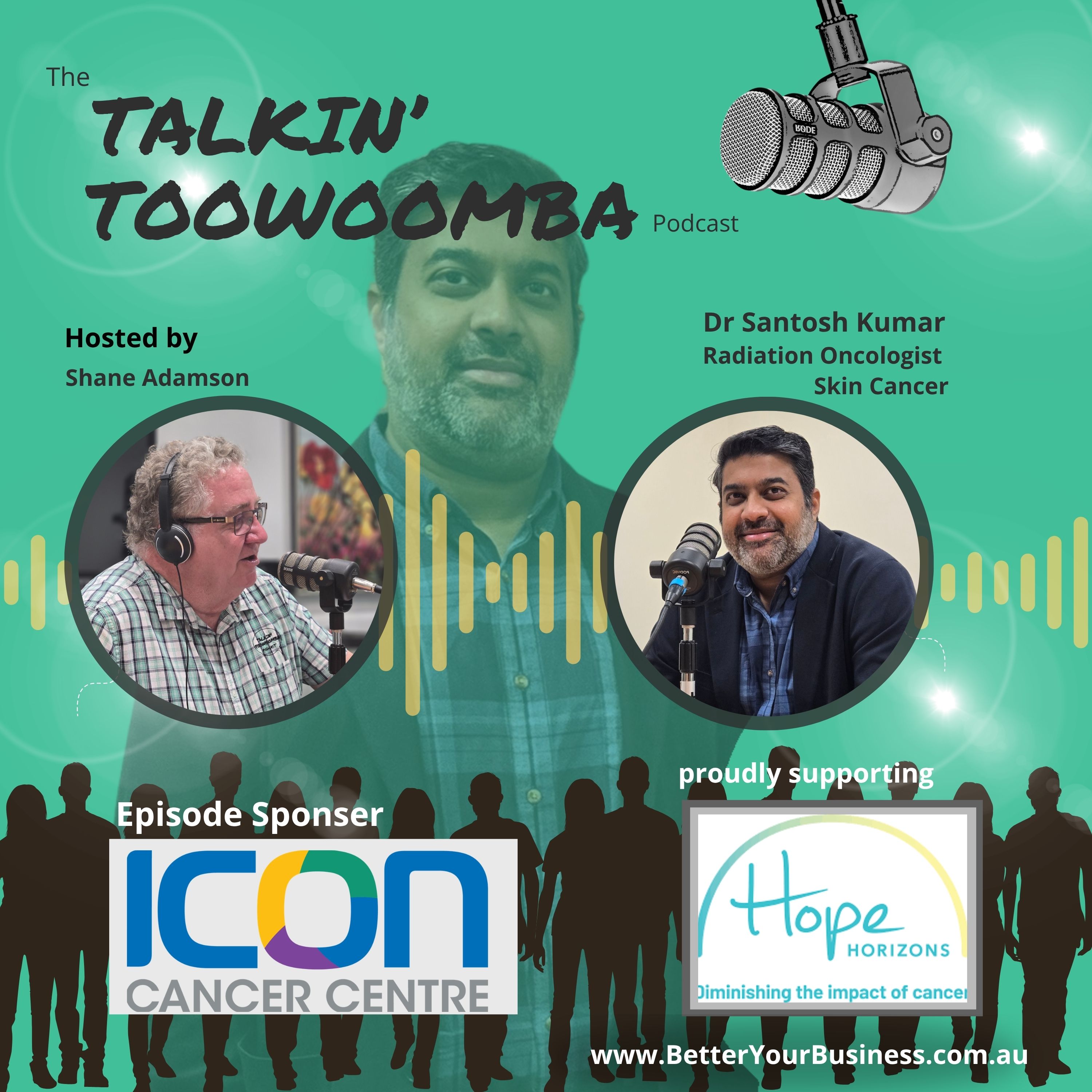
[00:00:03] Speaker A: Welcome to Talkin Toowoomba the podcast sharing real stories that matter. We're proud to partner with Hope Horizons, shining a light on the journeys of locals impacted by cancer and the incredible people who walk beside them every step of the way. Today's episode is brought to you by Icon Cancer Centre Toowoomba. The team at Icon Toowoomba have been caring for local cancer patients since opening in 2007.
Located on site at St Andrews Cancer Care Centre, Icon Toowoomba provides radiotherapy treatment for all cancer types, delivered by an experienced team who are dedicated to ensuring patients and their loved ones receive exceptional care every step of the way.
Icon Toowoomba also offers day oncology and haematology consulting. Patients are seen by one doctor for the duration of the treatment. A quick note before we dive in. The content of the Talk and Toowoomba Podcast is provided for general information and community interest only. It shouldn't be taken as professional, medical, financial or legal advice and must not be relied upon as such.
Please seek independent, qualified advice relevant to your own circumstances before making any decision.
Now let's get into today's conversation.
[00:01:24] Speaker B: Welcome to another episode of the Talkin Toowoomba Podcast. Today we're having a chat with Dr. Santosh Kumar, who is a radiation oncologist to do with skin cancer. Welcome to the podcast.
[00:01:35] Speaker C: Hi Shane, thanks for having me.
[00:01:37] Speaker B: So what are the main types of skin cancer that people should know about?
[00:01:41] Speaker C: So really, first things first. Queensland's the highest rate of skin cancers in the world, so we take this very seriously, not only as an oncologist but as a community as a whole. Most common skin cancers would be the basal cell cancers, squamous cell cancers and probably less frequently but more serious would be the melanomas. Most common BCC are the basal cell skin cancers.
Pretty common in the head and neck areas associated with sun exposure. Over the years they often present as a shiny nodule, bit red, bit raised around the nose, around the mouth. Most commonly sccs or squamous cell cancers is the second type of fairly common, can be crusty raised plaques again in around the head and neck area or sun exposed arms and legs. Finally, the melanoma skin cancer group, although more aggressive and more serious, is less common, looks very different to the SCC and BCCs and behaves fairly differently too, a lot more aggressive.
[00:02:40] Speaker B: So what would the warning signs be?
[00:02:43] Speaker C: So really each cancer is different in its own way. I think in terms of skin cancer management it would be noticing any moles that patients may have that change over time.
Probably worth having a chat with their local Skin doctors or their GPS to have a good look at that. Regular skin checks would be most appropriate. Probably the earliest way to find these skin changes. But other symptoms may include crusty lesions that are peeling, associated with pain, discomfort or bleeding at the site. Most commonly, you may also notice lumps or bumps in the neck if the lesions on the skin or forehead where results in nodal metastases or spread of these cancers into the parotid or the neck lymph nodes.
[00:03:27] Speaker B: What are the less common skin cancers that we're susceptible to?
[00:03:32] Speaker C: Just given the growing population, we do see a subtype called the Merkel cell cancer. So Merkel cell cancers again over years of UV exposure in older patient, possibly immunocompromised. Very common to see that in our population, in addition to more rarer forms such as cutaneous lymphomas or Kaposi's sarcomas.
[00:03:52] Speaker B: Can you just explain those two a little bit for me?
[00:03:54] Speaker C: Yeah. So lymphoma is essentially haematological, which is derived from blood cells or blood cancer cells. In this scenario, instead of circulating as a leukemia or lymphoma in the blood, they form skin lesions that appear to be like skin cancers. A sarcoma is a subtype of cancers which don't grow often from the skin, but can grow out onto the skin. Kaposi's sarcoma is the exception in that it does look like a stock standard skin cancer, but it is more aggressive and sarcomas routinely aggressive than your cutaneous or skin cancers.
[00:04:27] Speaker B: Okay, so typically on a basis, what's good sudden protection actually entail?
[00:04:34] Speaker C: Yeah, I think the message to get out there from really the podcast and the discussion today is what the media has been going on about for decades, which is often not taken on board as seriously, which is a slip, slop, slap. Really. That's the big takeaway really. If you're out and about spending time outdoors and in the sun, probably best to have lightweight, fully clothed shirt.
If you're wearing shorts, probably longer in length, and if possible, long pants would slop. Essentially the sunscreen of SPF 50 and above. There's certain areas that probably gets forgotten the most, which is behind the ears, on the feet, behind the neck, and probably be paying close vigilance to those sites. And then the slap would be a wide brim hat. Most patients get away with the cap. And we're finding that with UV exposure, we probably want more coverage and a more suitable hat.
[00:05:25] Speaker B: So is there times when we should be seeking shade perhaps?
[00:05:29] Speaker C: Yeah, look, with regards to skin Cancers, it does not mean you can't go out in the sun. It means that time frames from about 10am to 3pm where the UV index is the highest, probably best to seek shade. Other forms of protection will be wearing UV rated sunglasses or sun protection. And really most parts of the day, most locations will have high uv, UV index here in Australia. But staying away from reflective surfaces during those hours would also be beneficial, such as sand or concrete or water, where you can get a higher amount of UV exposure as opposed to just from the sun.
[00:06:07] Speaker B: So what you're saying is we also need to check the UV index if possible?
[00:06:12] Speaker C: Yes, that would be preferable. We know it doesn't happen as often, but yep, absolutely very useful.
[00:06:19] Speaker B: Is there extra care we should be taking for our children?
[00:06:22] Speaker C: So children are more susceptible to sunburns and does pose them at a long term risk of skin cancers, especially if they've got a family history or particular subtypes of skin. For those considerations and for those reasons really, we would say avoid direct sun as possible, especially if they're below the age of 12 and again trying to be in the shade for that 10am to 3pm where the UV index or suspicion is at the highest.
[00:06:48] Speaker B: So it's not a case of really avoiding going outside, it's managing when you are outside your exposure and so forth, isn't it?
[00:06:57] Speaker C: Absolutely.
[00:06:59] Speaker B: When should someone get a skin check?
[00:07:04] Speaker C: Well, in Queensland really, just given the heavy burden of disease we have most patients, we would encourage an annual skin check with either their GPS or dermatologists or skin specialists, particularly those who have had moles in the past would keep a close eye on the moles. And if the moles do change in appearance, whether it's the size or the color or the symmetry, would probably be warranting a sooner review. There are certain subgroup of patients who've had a heavy burden of skin cancer themselves, or a significant family history, genetic conditions or the immune system is down for whatever reason, either medication or surgery and so on. In that scenario, we'd be more vigilant with skin cancer. Routine surveillance and would be even going as frequent as 6 monthly.
[00:07:49] Speaker B: So when should a person be thinking, well, maybe I should be having one every six months rather than once a
[00:07:56] Speaker C: year, say often will be directed by the specialists or dermatologists or the GPs. Just given how many they probably have cut out or frozen out over the years. Also depends on their risk factors, particularly such as working outdoors.
UV exposure over a long period of time, if they continue to stay outdoors with poor sun protection and if their Immune system is affected more certainly would be considering a closer surveillance.
[00:08:21] Speaker B: Okay, so there's obviously different treatments for skin cancer. What treatments do we have available through yourself and the ICON Cancer Centre here in Toowoomba?
[00:08:31] Speaker C: Yeah, so before we get into specifically what we do, I just want to touch upon the fact that most skin cancers are low grade skin cancers and they're best suited in the community either through their gp, if the GP is comfortable and confident cutting these skin lesions out, or can have other treatments such as freezing the lesions, what we call cryotherapy, or using topical agents. When it comes to our intervention or our input into the treatments, it's really in the setting of adjuvant, what we call in addition to surgery for those high risk lesions, where we want to reduce the risk of the cancer coming back in the area.
There are a subgroup of population who are probably not suitable for surgery or decline surgery in that scenario. Radiation can be used as a standalone treatment option just to target the skin cancers. So in Toowoomba here to target the skin cancer, we have different techniques such as electron techniques or VMAT or volumetric arc techniques, with the aim that we shrink the tumor, get rid of any residual cells, any microscopic cells, and be able to spare the surrounding important structures such that cancers don't come back and patients can get on with their life after that phase of the cancer diagnosis.
[00:09:46] Speaker B: So let's delve a little bit into head and neck cancer.
What cancers are classified as head or neck cancers?
[00:09:54] Speaker C: So head and neck cancers is slightly different to the skin cancer group and cohort. So head and neck cancers defines or describes a group that really develops from tissues or organs inside the head and neck rather than the surface. Like the skin cancers, they are broken down based on the tumor site or the location, if you will, based on the anatomy. So the head and neck does include the nose, so you can have nasal related cancers. The throat is divided into three parts, such as pharynx. So the one behind the nose would be a nasopharynx, the one behind the mouth would be an oropharynx, and the one behind the lower part of the throat would be a hypopharynx. All of that would be considered in the head and neck area. And all of these have their own distinct tumor subtypes. The voice box in its own would be another site of disease, which we call laryngeal cancers. In Queensland, in our cohort here in Toowoomba, the most common cancer of the head and neck is actually a lymph node spread to the parotid gland or the lymph nodes in the neck that has come from a skin cancer somewhere in the head and neck area that has now spread to the neck. So a bit different from traditional head and neck cancers, but often treated in a similar way.
[00:11:10] Speaker B: Going to put you on the spot here. We hear, when we're talking about cancers of various types and cancer treatments, we hear the term lymph nodes.
Can you just explain a little bit what lymph nodes are and why they sort of hooked up with just about every type of cancer there is?
[00:11:31] Speaker C: Yep. So, essentially, anatomically, lymph nodes are structures, essentially nodules, which have multiple functions in our body. And in the head and neck specifically, there's about more than 500 of them. Also from head to toe, more than thousands of them. The main role of lymph nodes is to prevent infections, which is why sometimes you may have noticed that when you do get infections, they swell up and then they regress once the infection is gone. That's one of their major functions. Other functions include keeping fluid in the blood system rather than leaking out into our tissues and our skin. And so really, the downside of such good anatomy and physiology is that they're a great harbor for cancer cells spread from different parts of the body. So, specifically in the head and neck, if we're looking at skin cancers or other cancers from the tissue, from the deeper tissues of the head and neck, they often spread to these lymph nodes, making it one, more aggressive, two, a bit more challenging to treat, and therefore a higher risk of any spread outside of the head and neck.
[00:12:32] Speaker B: So I'm thinking about the head and the neck. Is there cancers that can develop, say, in your ears, for example?
[00:12:39] Speaker C: You can. You can. So most common lesions around the ears would be your skin cancers that we've previously discussed, including the SCC or BCC subtypes. Pretty rare to have ear canal cancers or other rare forms, maybe salivary gland cancers. We see that very infrequently. And if that's the case, it often catches us as a surprise, more than something we go chasing after.
[00:13:04] Speaker B: So if you were trying to help someone be healthy and look after their body, what are some symptoms that people may get that comes about because they've got head or neck cancers? What symptoms could they experience?
[00:13:18] Speaker C: Yes, this is an interesting one. The important message, I guess, to take away is whatever list that I follow on from here in terms of symptoms can also be noted in simple infections, common bugs. And that doesn't mean you press the alarm button on all of These symptoms, the important takeaway is that if these symptoms listed or discussed really are persistent, that's when we start to think, okay, may not be as simple as an infection or a toothache or earache. Really, the most common symptom we note is a painless lump, as we discussed with the lymph nodes. That's probably the most common. Often, as we've discussed with infection, it can regress, which may often give the patients and the local doctors that sense of relief that this may settle down with antibiotics. But often the persistence of it will point us to the fact that there's something else brewing. Other symptoms related to the throat cancers may be related to pain on swallowing, difficulty swallowing, a sore throat, especially when nutritional intake is compromised due to the swallow dysfunction. Weight loss and loss of appetite may also be noted.
If we're looking at the nasal side of things, where tumors of the nose rarely again, persistent symptoms such as a simple nasal blockage, nosebleeds, pain and discomfort around breathing. When we go look lower down below the throat and we're looking at the voice box side of things, it's an obvious change in voice. Now this often patients, families are telling us more than the patients are telling us where the partners or family members sound different. And in that scenario, we've got to be very careful. This is just not a simple bug that's not going away in perhaps a
[00:14:56] Speaker B: winter season because we all get a bit hoarse and crusty. Speaking in the throat doesn't necessarily mean it's cancer. It could be just a bit of an infection that your body's fighting and then it goes away. But if it's obviously very persistent or someone else is noticing it and you're not, it obviously warrants further investigation.
[00:15:16] Speaker C: Absolutely. That's the takeaway. And persistence can be different in terms of how long it's present for. I would say when it's there for a couple of weeks, I would seek medical attention either in the way to exclude a simple infection, abscess or collection, but also investigate thoroughly to make sure that it's not cancerous. The other point to note is that this often is a big challenge both for doctors in the community to pick up a cancer diagnosis. But often we see the opposite side where it's a delayed presentation and diagnosis for us, which I guess comes down to passing on that message to local doctors to have their antenna up for these persistent symptoms in the head and neck.
[00:15:58] Speaker B: What are the factors that increase the risk of developing head and neck cancers?
[00:16:03] Speaker C: So each subsite really has its own Very unique risk factors, but overarchingly in the head and neck, most common risk factors would be heavy smoking history, whether that's cannabis or tobacco use, heavy alcohol use, more than what is recommended or prescribed by the Liver foundations and the racgp. Other risk factors would include the risk of human papilloma virus or hpv. We've been seeing that more commonly in younger fitter patient who perhaps is not a heavy smoker or heavy drinker, but have contracted this virus, which often harbours around the head and neck area and then can present itself as a cancer of the head and neck. Now, at this stage, there's no real screening programs for hpv. The message to send out is patients, partners, you know, heterosexual partners who have had history of cervix cancer or have been on screening programs should be meticulous and consistent with their Pap smears to make sure they're not transmitting any of this HPV virus, which is very common for them to predispose them to cervix cancer. So really a combination of lifestyle factors related to smoking, alcohol and then the virus. If I may also add, we do have a population of patients who actually aren't smokers or heavy drinkers and they do have a risk of oral cancers with poor dental hygiene and having not looked after their teeth for a long period of time or not seen their dentist. Oral ulcers is probably one of the most common reasons and sites of oral cavity cancers of neglected dental work.
[00:17:38] Speaker B: So here in Toowoomba, at the ICON Cancer Centre, what treatments are available for neck.
[00:17:43] Speaker C: So for the head and neck treatments, a bit different from the skin in that these lesions are a lot more deeper into the anatomy and into the body. And here we do have the volumetric arc therapy or VMAT technique, which is highly specialized radiation to target these important structures and tumor sites, with the aim to spare what we call organs at risk or important structures in the head and neck around the tumors, such that we limit the side effects in the short and long terms. So VMAT technique is probably most targeted treatment technique that we offer here. There is other treatments such as intensity modulated radiation therapy treatment, which perhaps has gone a bit out of favor and we use it less frequently. We also do have serotactic guided radiation therapy, which is essentially a high dose of radiation targeted to a very small area.
The evidence around this in the head and neck is limited. So often we do use stereotactic radiation treatment for treatment of brain tumors, prostate lesions and bone lesions rather than those that we're going for. A cure in the head and neck.
[00:18:48] Speaker B: Is there anything we haven't talked about that you think you would like listeners to, to know or to consider when they're thinking about their body and the risk of cancer?
[00:19:03] Speaker C: Well, a couple of things come to mind really would be regular skin checks through your GPS or your skin specialists. That's extremely important. As much as we're oncologists, we're here to help out the community to avoid these high risk lesions and if they are low risk lesions, to be targeted and stopped early, in early stages. With regards to the cancers of the head and neck, it is complex radiation treatment and we do work as a multidisciplinary team. We often don't have one treatment specialty such as an oncologist or a surgeon making these decisions. So a lot of these decisions are carefully discussed, considered before decisions have been made for patient outcomes and care based on evidence. We'd like to think we work based on the evidence, but also what's best for the patient both in the short term and long term for their cancer outcomes. One last thing I'd like to add. You know, the cancer journey is, you know, as much as it's physical, it's also mental. And you know, these cancer diagnoses often come out as a surprise and shakes up the patients, families and their support network takes them out of work and so on. It's important for our listeners to know that even if it's not specific to head and neck cancers, that there are services out there, much like your podcast, many other services around there where patients can seek help, counseling and even just ear to listen to help them with their journey. That's equally important if not more than our radiation planning and treatment for many of those patients to get them through their cancer diagnosis and treatment.
[00:20:35] Speaker B: Dr. Santosh, I want to thank you for coming on the podcast today. I hope that people listening to this episode will get a bit better idea and have a bit of an understanding if they do get diagnosed with a cancer such as to do with the head or neck or with skin cancer. And I look forward to catching up with you again sometime.
[00:20:56] Speaker C: Thanks so much. And I hope to see you not in our clinics, but at the podcast sometime or socially in town. But thanks for having me. It's been a pleasure. Thank you.
[00:21:03] Speaker B: You're most welcome.
[00:21:04] Speaker A: Thanks for joining us on Talkin Toowoomba. If today's episode inspired you, please share it to help spread hope and connection right across our community.
A special thanks to our sponsor, Icon Cancer Centre, Toowoomba. Since 2007 the team at Icon Toowoomba has provided expert cancer care from St Andrews Cancer Care Centre, delivering radiotherapy, oncology and haematology services with personalised support every step of the way. And as always, a big thank you to Hope Horizons for their incredible contributions Contribution to local families living with cancer. The content of Talkin Toowoomba Podcast is provided for general information and community interest only.
It should not be taken as professional, medical, financial or legal advice and must not be relied upon as such.
Please seek qualified advice relevant to your own circumstances before making any decision.
Until next time, keep talking Toowoomba