Episode Transcript
[00:00:09] Speaker A: Welcome to Talkin Toowoomba, the podcast sharing real stories that matter. We're proud to partner with Hope Horizons, shining a light on the journeys of locals impacted by cancer and the incredible people who walk beside them every step of the way.
Today's episode is brought to you by Icon Cancer Care Centre Toowoomba. The team at Icon Toowoomba have been caring for local cancer patients since opening in 2007.
Located on site at St Andrews Cancer Care Centre, Icon Toowoomba provides radiotherapy treatment for all cancer types, delivered by an experienced team who are dedicated to ensuring patients and their loved ones receive exceptional care every step of the way. Icon Toowoomba also offers day oncology and haematology consulting.
Patients are seen by one doctor for the duration of their treatment. Quick note before we dive in. The content of Talking Toowoomba is provided for general information and community interest only. It shouldn't be taken as professional, medical, financial or legal advice and must not be relied upon as such. Please seek independent, qualified advice relevant to your own circumstances before making any decision.
Now, let's get into today's conversation.
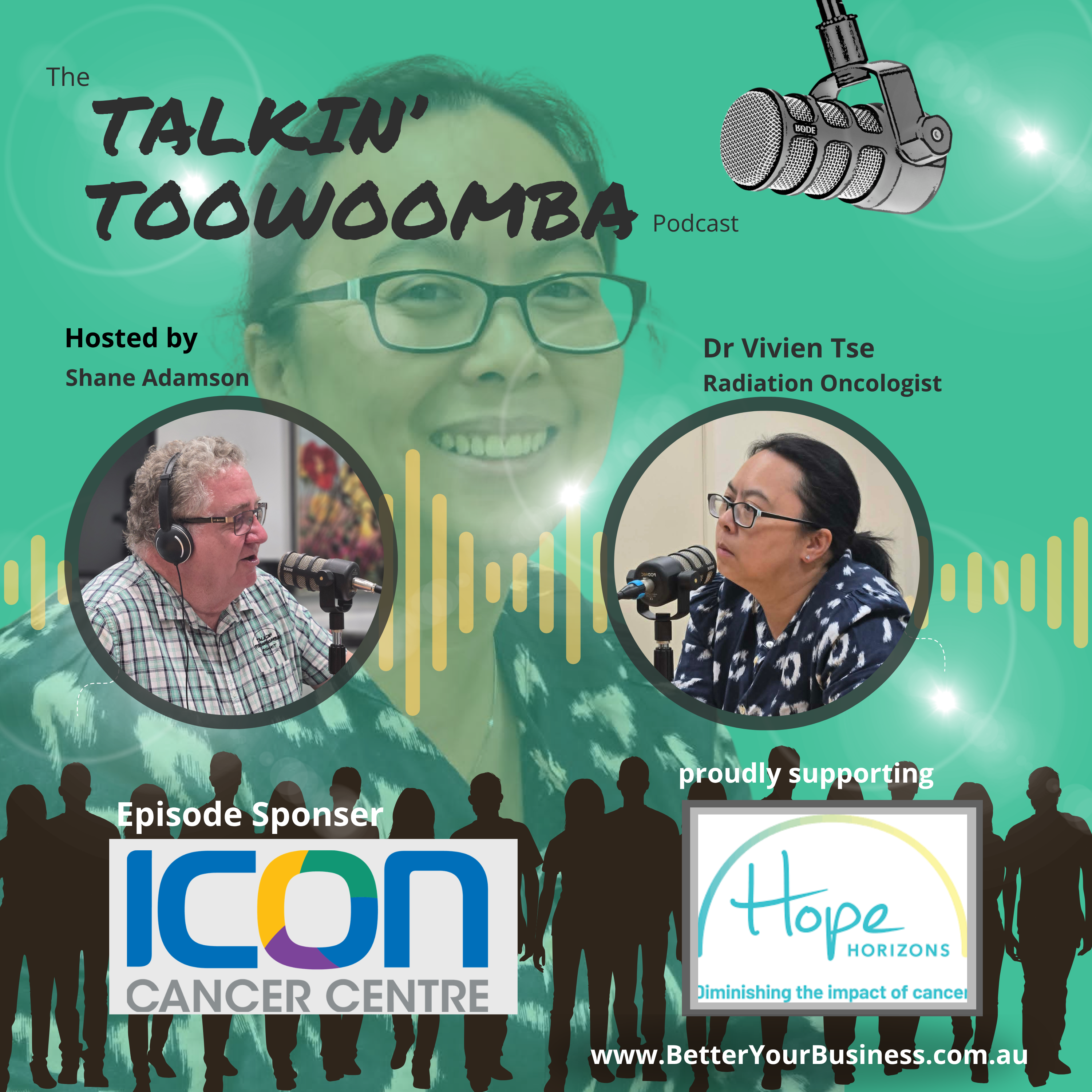
In today's episode of the Talking Toowoomba podcast, we're speaking with Dr. Vivian See, who's a oncologist here at the Icon Cancer center here in Toowoomba.
Welcome to the podcast, Dr. Vivian C. Thank you, Shane.
[00:01:46] Speaker B: Nice to meet you.
[00:01:47] Speaker C: Officially, I'm here, but, yeah, everyone calls me Dr. Viv because the surname can be a little bit tricky sometimes.
[00:01:54] Speaker A: All right, so, Dr. Viv, tell me, can you explain to me a little bit about, for our listeners what prostate cancer is?
[00:02:03] Speaker B: Sure. I mean, prostate gland is something that only men have.
It's essentially a gland that produces, stores and secretes semen and really has very little other function. But the location of it is such that it can affect your waterworks because it. It's usually between your bladder and the top of the penis.
[00:02:26] Speaker C: So if it's enlarged, often it reduces your flow and can cause some difficulties urinating.
And any cancer essentially is an overgrowth of that particular organ.
[00:02:37] Speaker B: So cells within that organ lose their control mechanisms and they just keep growing
[00:02:44] Speaker C: and keep growing without any sort of stop sign, essentially.
And for a prostate cancer, it's within
[00:02:50] Speaker B: the prostate gland, any part of that prostate gland.
[00:02:53] Speaker A: Okay.
Now, there's obviously some early warning signs and symptoms that men should be watching for. Could we just chat a little bit about those?
[00:03:02] Speaker C: Yeah. Actually, the majority of men don't have symptoms.
[00:03:06] Speaker B: The sort of symptoms that people can get are typically difficulties with urination. Now, whether that's a slowing down of the flow, more urgency, more frequency, or, you know, difficulty actually holding onto it.
But because it's also that gland that secretes semen, for some men, there's no problems with the waterworks at all. And it's actually erectile problems.
Of course, a lot of these symptoms can be causing, you know, can be
[00:03:33] Speaker C: caused by other things such as a
[00:03:35] Speaker B: urine infection or, you know, erectile problems
[00:03:38] Speaker C: can be just from medication, whether that's blood pressure medication or diabetes medication.
[00:03:42] Speaker B: So I think the most important thing is if anyone does have those symptoms and they're worried, just go and see your gp, get it checked out. It could be something very, very straightforward like a urine infection.
But as I say, most men actually don't have symptoms. The majority of men are picked up either because they've asked for one, or the GP has just routinely checked a PSA blood blood test.
[00:04:05] Speaker A: Okay, we'll come back to the PSA blood test shortly.
Just in this. So this early stage of somebody thinking that, you know, males thinking that he might be getting or doesn't want to get prostate cancer, is there anything he can do in his general health and his general activities to try and mitigate the chances of getting prostate cancer, or is it just the luck of the draw?
[00:04:31] Speaker B: A lot of it is the luck of the draw.
Certainly as men get older, the risk is higher risk.
[00:04:37] Speaker C: The rate of prostate cancer is about one in five men in Australia.
The sort of things that you can't
[00:04:43] Speaker B: change will be family history. So if you have a direct family member, whether that's your father or a
[00:04:48] Speaker C: brother with a prostate cancer, then that person's individual risk is doubled.
So obviously you can't do anything about that or your ethnicity.
[00:04:55] Speaker B: So there's certain ethnicities that have a
[00:04:58] Speaker C: higher risk of prostate cancer or a more aggressive prostate cancer.
But the sort of things that people can do, I mean, essentially they're just
[00:05:05] Speaker B: general, healthy lifestyle type things. You know, if you keep active, try not to be too overweight, because that can certainly increase your risk.
And, you know, there's a few things
[00:05:17] Speaker C: about certain diets that potentially might increase your risk, but I think it's. It's harder to prove those ones, but definitely being overweight can increase it.
There's been some sort of speculation about
[00:05:34] Speaker B: whether people that regularly irritates their prostate gland. So people that horse ride or, you know, professional cyclists, for example, that constantly irritating their perineum down there, that might cause more of a slightly higher risk as well.
But I think they're anecdotal in their people that are in the public eye already.
[00:06:00] Speaker C: So they're looking at that.
[00:06:01] Speaker B: I don't think there's any science behind it just, just yet.
[00:06:05] Speaker A: Okay, so there's obviously these. I know there's a blood test and this that you can have. Can we just talk about a. Having that blood test? And when should we start, us males? When should we be starting to think about doing this if we're not already prompted by our gp?
[00:06:24] Speaker C: Definitely if you have a family history. So I think if you're over 40 and you've got a family member that
[00:06:29] Speaker B: has had prostate cancer in their lifetime,
[00:06:31] Speaker C: I think you should be talking to your GP about, you know, screening for that, because it's a very simple blood test.
[00:06:38] Speaker B: So if you don't have a family history, look, there's been a lot of
[00:06:46] Speaker C: toing and froing in the guidelines as to whether GP should be screening for
[00:06:50] Speaker B: PSA and prostate cancer or not.
And certainly quite some time ago, people were routinely screened.
[00:06:58] Speaker C: Gps would do this PSA blood test every year, whether you ask for it or not.
And then they actually took it out of the GP guidelines and I think
[00:07:07] Speaker B: they've only really reintroduced it in the last year or so.
[00:07:10] Speaker C: And part of the reason for not
[00:07:12] Speaker B: doing it or the arguments for not doing it was over diagnosing, over investigating a lot of people putting people through a lot of stress and anxiety to
[00:07:22] Speaker C: pick up a cancer that actually, for
[00:07:25] Speaker B: the majority of men, may actually never need treatment because they're, you know, prostate cancer is usually a very slow, indolent cancer. And although one in five men may get it, many people will actually die with prostate cancer, potentially never having needed
[00:07:42] Speaker C: any treatment, rather than because of prostate cancer.
So obviously there's a big drain on, you know, the health system for over
[00:07:51] Speaker B: investigating and over stressing patients.
So I think it's just about being more sensible about who you, who you select to screen. I think if any patient asks doctor their GP to can I have a PSA test? I don't think they should say no because I think it's very easy and I don't think you can really come back from, oh, I asked for one and I never got it.
[00:08:14] Speaker C: But I think, you know, generally the average age of men that get prostate
[00:08:19] Speaker B: cancer is actually in their 70s.
[00:08:22] Speaker C: So I think if you've got a family history over 40, you should start,
[00:08:26] Speaker B: if you don't have a family history, probably over 50.
[00:08:30] Speaker A: Okay. So, as some of the listeners know, I'm going through a prostate surgery cancer journey myself. I've already had surgery and we'll talk A little bit more about this shortly.
But what's the process for someone who has been doing the right thing, trying to be healthy and choice of lifestyle, and they've been getting their PSA test with their GP and then all of a sudden there's an elevation in the PSA level. What's the process then to say, okay, we need to do something, we need to do some kind of treatment? How do they get to that point? What's the process of. I suppose you could say diagnosing that, yes, you have got prostate cancer after a blood test indicates that you may have.
[00:09:24] Speaker C: Yeah, I mean, the first thing your
[00:09:27] Speaker B: GP will do is probably repeat it, check whether you've got any urinary symptoms that could suggest a uti, so an actual infection, because that can actually falsely put the PSA up anyway.
[00:09:39] Speaker C: So if they've treated any possible infection,
[00:09:41] Speaker B: they've repeated the PSA and it's still high, then they usually will refer you to a urologist.
[00:09:47] Speaker C: So urologist is a surgical specialist that deals with anything, kidney, bladder, prostate in general.
So they'll take a history, take your
[00:09:58] Speaker B: family history, and then they'll examine you. So they will actually try and feel the prostate from your rectum.
[00:10:05] Speaker C: So they'll pop a finger up your bottom. They can only really feel the back
[00:10:09] Speaker B: part of the prostate, but if that feels abnormal, or if they're just particularly concerned because of a family history or that psa, they'll then send you for an MRI scan.
[00:10:21] Speaker C: And the MRI scan will have a
[00:10:23] Speaker B: look at the prostate, see if it's enlarged, see if there's any abnormal lesions within that sort of abnormal areas that could be suspicious of cancer.
[00:10:33] Speaker C: Now, for some people, their prostate, sorry, their PSA is elevated because of just a benign swollen prostate gland.
[00:10:40] Speaker B: So the prostate gland on average is
[00:10:42] Speaker C: the size of a walnut.
And you can imagine if a man's prostate is twice the size of that,
[00:10:48] Speaker B: even if it's completely normal, then you'd expect the PSA to go up with that and it's just completely normal.
So if the, if the MRI is normal, they may just sit tired and just watch it and make sure that it's not continuing to go up.
[00:11:01] Speaker C: If there is an abnormal area seen on the mri, the next step is usually a biopsy.
[00:11:06] Speaker B: So typically a day case surgery, you get put to sleep and they'll take multiple biopsies from the prostate, so those little cores of tissue get sent off to the lab. Now, they usually don't just biopsy the one spot they see abnormal on an mri and they Typically scatter the biopsy all throughout the prostate gland.
[00:11:26] Speaker C: And often that's because you can see, or sometimes we find prostate cancers that don't always show up on the MRI scan as well.
Once we know that it is a
[00:11:38] Speaker B: cancer, the next step usually is a PET scan.
There's lots of different types of PET scans, but there is a very specific prostate cancer PET scan.
It's called a PSMA PET scan.
[00:11:50] Speaker C: And that PET scan looks at the whole body.
[00:11:52] Speaker B: So the MRI really is just focusing on the prostate and the pelvic area, whereas the PET scan is literally from top to toe.
[00:12:01] Speaker C: And what that will give us is
[00:12:03] Speaker B: a much more sensitive pickup rate of any prostate cancer that could be anywhere in the body.
And it can pick up some abnormal lymph glands, even if they look normal on an MRI scan. So much, much more sensitive.
[00:12:17] Speaker C: And then that those two scans and
[00:12:19] Speaker B: the biopsies will help us determine how. How much of a risk that prostate cancer is.
[00:12:24] Speaker C: You know, low, middle, or high risk of it causing problems.
And then that can help us determine, actually, does this patient need treatment?
[00:12:33] Speaker B: Can we just watch it? Because it's unlikely to cause any problems in the next 10 or 20 years,
[00:12:38] Speaker C: or is actually this person someone that we need to actively think about treating?
[00:12:45] Speaker B: And obviously, the treatment depends on whether that cancer is confined to the prostate gland or. Or not.
[00:12:50] Speaker C: And there's lots of options depending on
[00:12:53] Speaker B: what stage people are at.
[00:12:57] Speaker A: Now, my journey was that I had the biopsy, and, yes, it was discovered that I definitely did have prostate cancer and that the Gleason score was quite high.
And so obviously, you know, we had to do something.
Spoke about the different options of different treatments that was available to me.
I decided at the time to have the.
Well, they call it radical removal of the prostate.
[00:13:32] Speaker C: Prostatectomy.
[00:13:33] Speaker A: Yep, that's the one. Thank you for that. I always trip over that one to obviously give myself the best chance of removing the cancer. So that's what we did.
But of course, what's happened now is for a couple of years after the surgery, I was hunky dory with my PSA levels, but then in the last year or so, they've started to climb up again.
Pardon me. Sorry. And obviously, I've got to look at some other treatments. Can you just. First of all, before we go into any details, because I'm willing to share where I'm at with my journey in a minute. But before we get to that, can you just sort of go through the. The different options that. That. That you have as far as treatment for Your prostate cancer.
[00:14:23] Speaker C: Yeah. So when you've had the scans that confine that. Sorry, when you've had scans that show that your prostate cancer is confined to the organ, then you usually have two, two options of active treatment.
[00:14:35] Speaker B: Now, there may still be an option of what we call active surveillance as well, where you don't have to treat. But in terms of active treatment, you either remove it surgically, so the prostatectomy that you mentioned, or you can actually zap it with some radiation treatment.
And we do the radiation treatment here
[00:14:52] Speaker C: at the ICON Cancer Center. So radiation is just X ray therapy.
[00:14:57] Speaker B: Instead of having to go to hospital, have a five hour operation, recover for maybe three days in hospital, and then
[00:15:04] Speaker C: recover at home for potentially six weeks afterwards.
It's a much more drawn out process with radiation. You know, typically you're here every day, you get a 10 minute appointment, lie
[00:15:14] Speaker B: on the radiotherapy machine for about 5 minutes.
The radiation is no different to having an X ray or a CT scan. So you don't feel anything at the time. We simply direct and focus the radiation X ray beams onto the area that we're targeting, in this case the prostate, and then it slowly kills the cancer. But it's not a one visit, it's often a multiple visits. And it can vary depending on how much of the body we're tracing. But it can be anything from five
[00:15:43] Speaker C: up to potentially 39 treatments.
But it does also get rid of
[00:15:48] Speaker B: the cancer in the same way that surgery does. So you don't, you certainly don't lose the cure rates. It's not an inferior treatment from that point of view, but it's a much longer journey. And so for our patients that are from out of town, it might not
[00:16:01] Speaker C: be as feasible to live in Toowoomba for four weeks or six or eight
[00:16:04] Speaker B: weeks compared to a three day hospital admission.
[00:16:09] Speaker C: But the side effect profile is very different. So often when a patient's been diagnosed
[00:16:14] Speaker B: by the urologist with a localized prostate cancer, they will say, right, this is what surgery will entail.
[00:16:20] Speaker C: And often they send an appointment, they send a referral to us, you come and talk to us and we'll explain what radiotherapy will entail.
[00:16:27] Speaker B: And again, depending on the risk of the cancer, sometimes that's with short term hormone therapy as well.
So often it's about just providing a patient with all the options or the different side effects and then for that patient to decide what's the best thing for them.
And it's largely patient preference.
[00:16:48] Speaker A: Okay. So as I said, I opted to have the surgery.
And for a couple of years there I was, my PSA levels were almost non existent and we were thinking, yep, everything's going really well.
And then we got a knock on the door from a PSA level blood test to say they're climbing up again. And so we've been monitoring it. Now we've got to the point, and I'm actually fortunate to have you as, as my, my specialist doctor.
You are going to put me through a treatment of radium.
How common is it for someone who's had the, the prostectomy to then have to revisit a treatment because the cancer's still there? Is it a high rate? Is it a low rate? Is it just luck of the draw?
[00:17:45] Speaker C: It's certainly more people don't require further treatment than do.
[00:17:50] Speaker B: I'd say it's probably one in three that actually do require treatment.
[00:17:54] Speaker A: Trust me to be the one.
[00:17:57] Speaker C: So.
[00:17:57] Speaker B: And you know, in your case, as when we took the tumor out, we had what we call clear surgical margins. So we actually thought we did have it all.
[00:18:06] Speaker C: There was a good rim of normal tissue around the tumor.
[00:18:11] Speaker B: So. But we have situations where people have their surgery and the cancer goes right up to the edge of the specimen. So we actually say they have a positive margin.
[00:18:20] Speaker C: And even in those situations, actually only one in three of those people even
[00:18:24] Speaker B: get to a point where they, they need the radiation.
[00:18:28] Speaker C: So, yeah, so it's definitely not common in terms of the proportion of people that need it.
But yeah, one in three, I think some would say is still pretty, pretty common. But no, a very, very good chance that with surgery people can be completely cured.
[00:18:46] Speaker B: I'd like to think of the radiation
[00:18:48] Speaker C: treatment that we do in this scenario following the prostatectomy as a second chance of cure.
You know, it's a backup plan to mop up anything that is still there having had the operation.
[00:19:02] Speaker A: Okay, so I think in a couple of weeks time I'll be starting and I'm having 33 treatments from memory.
What, what, what am I, what can I expect? What, what am I going to experience?
I know you've explained that. I come in, I sit in the machine for about five minutes and then I'm off again. But what, what can I expect to feel or not feel? And how is it likely to affect me ongoing during that treatment period? Is there any.
And I know everybody's different and it's not one rule, one size fits all. But what, what, what are some of the possibilities from being a good experience to perhaps a not quite so good experience?
[00:19:57] Speaker C: Yeah, I mean, I think whether you have a prostate gland still in, or
[00:20:02] Speaker B: whether you've had it out, the side effects are pretty similar, so it would be relevant across the board.
[00:20:08] Speaker C: Most commonly people will feel a bit
[00:20:10] Speaker B: tired and, you know, radiotherapy side effects
[00:20:13] Speaker C: don't generally start immediately from your first day.
[00:20:16] Speaker B: Typically for the first two weeks of treatment, you do feel a bit tired
[00:20:20] Speaker C: simply for coming here every day.
[00:20:22] Speaker B: You know, obviously if you live close
[00:20:24] Speaker C: by, it's not as much of a journey. Some people travel an hour, two hours a day each way to come, so
[00:20:29] Speaker B: obviously that adds to the fatigue too.
[00:20:31] Speaker C: But the fatigue certainly from a radiation point of view is usually it's noticeable, but it's not, it's not limiting you in terms of what you do.
[00:20:42] Speaker B: So, you know, what I tend to tell my patients is that we have
[00:20:45] Speaker C: people that come in, have a six week course of radiation and can still hold down a full time job if they're local.
So yes, you'll feel a bit fatigued. If you have a quiet afternoon in front of the telly, you'd probably have a snooze, but actually if you were busy, you'd still do everything you would do and you'll probably just find that you're ready for bed a little bit earlier or you'll sleep a little bit more soundly.
Having said that, you know, from a, from a prostate radiotherapy point of view, one of the things we get you to do is to make sure you're well hydrated, that you're drinking well throughout
[00:21:21] Speaker B: the day and that when you get on the machine to have your treatment
[00:21:24] Speaker C: that you've actually got a full bladder and ideally you've emptied your bowels in the morning before.
[00:21:29] Speaker B: Now both of those things help to
[00:21:32] Speaker C: reduce the side effect profile because the bladder is a very good balloon essentially that helps to push all the bowel loops away from where we've got a hit. Which means that you get less bladder and less bowel side effects.
[00:21:46] Speaker B: But typically the side effects from your
[00:21:49] Speaker C: waterworks will be frequency. So going more often, bit more urgent,
[00:21:54] Speaker B: the flow can slow down, especially if
[00:21:56] Speaker C: you still have a prostate gland in.
And then the urinating, urinating can be a bit uncomfortable. So you can feel like your ordinary run of the mill cystitis.
And effectively it is, it is inflammation of the bladder, but in this case not from an infection, but from radiation. But that's something that builds up very slowly week on week over the six week period and, and then usually the radiation treatment side effects peak two weeks after you finish and then it all gradually settles back down Again so for most people by six to eight weeks after radiation treatment, side effects are largely back to normal from a bowel point of view.
We again similarly increasing frequency and urgency.
I often joke with my patients that it's a very extreme treatment for constipation.
So people can have a long standing history of constipation, have their treatment and actually find that they don't need to touch their laxatives during and potentially after the treatment as well.
But so yeah, frequency, urgency, maybe some diarrhea. Now either of those side effects in terms of bladder and bowel, there are very good medications over the counter ones that can help to alleviate that. Your typical anti diarrhea treatments like gastro stop and your usual cystitis medications like Euro for instance, example. So you can just pick them up in your normal, you know, woolies or coals or whatever and you know, they often help to alleviate the side effects so that most people actually get through treatment quite well.
And the majority of men will come through the other side and be like, oh actually that was surprisingly easy. Yeah, of course you do have individuals that, that do struggle and there's no real way of predicting who those people are going to be. So it's not like if you're someone that's really sensitive to the sun and you get sunburn easily that you're going to burn more easily from the radiation.
It's just, it's just potluck.
There are certainly some situations that do exaggerate the side effects. So you know, smoking for example.
So we always encourage people to, to stop smoking if they can, not just from a lung health but actually it does reduce your radiotherapy side effects. You need the oxygen to the area to help it heal. Y okay, you know, staying well hydrated and just resting, listening to your body eat, drink, rest and that's going to be the best way to help you, you know, cope with, with the treatment.
[00:24:18] Speaker A: Now I'm going to touch on a subject that men probably don't like to talk about and part of that subject is, is whether I'm going to have prostate cancer or not. But I mean men tend to stick their heads in the sand a bit.
So I'm hoping by asking this question that there might be someone who listens to the episode and goes, glad he asked that. I've always wanted to know, but I wasn't going to ask.
I know there was a chance after I'd had the surgery that I may have lost sexual function.
Luckily for me, I was one of the lucky ones and I didn't is there a chance from having the radium that that could happen?
And I suppose the second part of the question is if, if I'm not experiencing any dysfunction, shall we say, is it safe to continue to be sexually active with your partner even while you're having perhaps the treatment, if you're feeling up to it?
[00:25:27] Speaker C: Yeah, no, really, really good question.
I think you are sort of certainly in that group of the lucky ones that did retain their sexual function after surgery.
And so you had something called a nerve sparing prostatectomy.
Some men aren't suitable for that because their tumor is sitting right where those nerves are. So, you know, you can't spare that area because you risk leaving cancer behind.
[00:25:50] Speaker B: So for having come through surgery with,
[00:25:52] Speaker C: with good erectile function, unfortunately, radiation can, can affect it. It's not a guarantee, but you know, where those nerves and, and blood vessels are that they could leave behind with radiation, that is still a high risk area that could be harboring cancer cells. So we do have to hit that with the radiation treatment.
I would say that coming into radiation with good functioning erections, it's probably, you know, 40 to 50% chance that you will lose it, whereas 60%, 50 to 60% chance that you'll actually retain it.
And when we say that you, you know, you have some dysfunction afterwards, it, it's not, it may just be noticeably, a little bit worse, but you still don't need medication. It may be that actually simple things like Viagra or Cialis, so just normal prescription medications can actually help.
And there's other more intensive sort of erectile dysfunction treatments potentially all the way up to having a prosthetic inserted surgically. So there's lots of treatment options for erectile dysfunction.
But I think, you know, most men come into prostate cancer treatment already with a long standing history of erectile dysfunction or if they're already on Viagra, for example, unfortunately, those men, whichever treatment you
[00:27:15] Speaker B: have, they're, they're really likely to, for
[00:27:17] Speaker C: things to get worse.
But no, I would say, you know, probably 50, 50, 60, 40 chance that you'll retain things certainly if you're feeling energized and everything's working, certainly from a radiation point of view, nothing to stop you from carrying on during your radiation.
You're not radioactive through it, so you're not going to be a risk to your partner in any way or to yourself.
So no, absolutely, continue as you wish.
[00:27:52] Speaker A: Okay, so let's talk about the ICON Centre here in Toowoomba.
There's obviously different options and different treatments are available.
What other options for treatment are available for someone, a male with prostate cancer?
[00:28:10] Speaker C: So with prostate cancer that's confined to the prostate, it is really surgery or radiation as the, the backbone.
I touched on earlier that if you've got slightly more advanced disease, even if it's contained, there may be a role for some hormone therapy.
Now, we know prostate cancer is driven to grow by testosterone. So testosterone being the male sex hormone. And if you switch that off with medication, you essentially put you into a male menopause. But by doing that, prostate cancer cells go to sleep. They haven't got what they're feeding off to grow, and therefore they shrivel up and sleep.
But the key thing is that they don't die.
Problem with that is it's a, well, it's a very good treatment for maintaining
[00:28:54] Speaker B: and controlling a prostate cancer or enhancing
[00:28:57] Speaker C: the, the cure rates and the effect
[00:29:00] Speaker B: of the radiation treatment.
[00:29:01] Speaker C: But it comes with a whole host of side effects.
[00:29:05] Speaker B: And, you know, we've talked before as
[00:29:07] Speaker C: well about, you know, whether there's a role for hormone therapy in your case and whether it's something you're, you know, wanting to expose yourself to.
And, you know, the typical side effects of hormone therapy and menopause are really no different to women that go through menopause.
So we usually get a bit of a chuckle from the patient's partners at this point when we say we're going to put them into menopause.
So, you know, typically, again, fatigue, potentially more significant fatigue than radiation fatigue, largely because it lasts longer, but for most, again, still able to function, do your normal things.
[00:29:50] Speaker B: But with that lack of testosterone, people
[00:29:53] Speaker C: can get hot flushes.
So it can vary from, you know, twice a week hot flushes that might last 10 seconds. You just get a warm feeling, run over you.
It can be as bad as 30 hot flushes a day and night where you're hot and you're sweating and you're changing your T shirt, changing your sheets.
And so, you know, how often that happens will affect how that affects you.
But the thing with hot flashes, often it also is that, you know, if we did have to put someone on, even if it was lifelong hormone therapy, in the same way as most women don't have hot flushes their entire postmenopausal life, the hot flushes often do improve over time.
So but there are actually medications that can help with that.
So fatigue hot flushes, it can put on some weight, especially around the tummy.
So, and we know that know increasing abdominal weights, abdominal girth, does increase your risk of type 2 diabetes and there's a knock on effect in terms of cholesterol, blood pressure, you know, heart attack
[00:31:02] Speaker B: risks, things like that.
[00:31:04] Speaker C: So it's important to, you know, maintain your exercise to try and not put on weight.
[00:31:09] Speaker B: Because actually one of the things where you lack testosterone is you lack your,
[00:31:12] Speaker C: you know, you get muscle wastage. So not only are you tired, but your muscles also feel weak. So depending on what sort of work you do, you know, if we have, we look after a lot of farmers
[00:31:23] Speaker B: in the area, for example, and they might choose not to have hormone therapy
[00:31:27] Speaker C: because actually they still need to maintain their, their farm.
[00:31:31] Speaker B: I think important ones to talk about that's, you know, certainly been in the
[00:31:35] Speaker C: media in recent years is the emotional aspect.
[00:31:38] Speaker B: You know, we know there can be a mental health element, especially if you have a background of depression and things like that.
[00:31:47] Speaker C: Because often hormone therapy or menopause can make you a bit more emotional. Whether that's teary emotional or that's cranky, short tempered emotional.
And you know, if people have a background of depression, for example, especially if
[00:32:01] Speaker B: they're medicated, we definitely know there's a,
[00:32:04] Speaker C: you know, the much higher risk of suicide. So it's important that know we know everything there is to know about your health and your background. So counsel you on, look, should we do the hormone therapy or not?
[00:32:15] Speaker B: And also then be aware of any side effects that are happening. Because as you say, you know, a lot of men do put their head in the sand about various different side effects, erections being one of them. But actually if they're feeling depressed or anxious, they often don't talk about it either. So it's actually being able to, you know, check in with, with, with them
[00:32:35] Speaker C: and then coming to the, that sexual side, you know, no. Testosterone often means lack of libido, so lack of sex drive. So the desire is not there.
But that's not to say you can't still use Viagra and still be able to get that erection and maintain a sexual relationship with your partner.
But, and pretty much all of those side effects we've talked about do settle down when you come off the hormone therapy. So if you don't have to be on it long term and we, you know, prescribe just a limited course of treatment when your testosterone recovers from that and that, that can vary how long it takes. I'd say on average for your average 70 year old, it's about 12 months after you finish.
[00:33:17] Speaker B: So we might say we want to
[00:33:19] Speaker C: give you hormone therapy six months, but actually in reality it's another 12 months before you recover from the menopause. So all of those symptoms do, do resolve.
I'd say the one that probably doesn't
[00:33:33] Speaker B: resolve is that your testicles in your penis can shrink.
[00:33:38] Speaker C: And, you know, people are very different in terms of whether any of these side effects bother them that much or not.
There's definitely some that, you know, that's the, the one most important and debilitating side effects of all. And for some, especially if they don't have a partner or they're not sexually active, you know, they don't even bothered about it.
[00:34:02] Speaker A: Yeah.
[00:34:02] Speaker B: Yeah.
[00:34:02] Speaker C: And I think that's the hard thing about, you know, giving your patients all
[00:34:07] Speaker B: the information that you can. There's such a, a long list of,
[00:34:10] Speaker C: of side effects that can happen.
[00:34:12] Speaker B: You know, our role is to try and give you that and counsel you
[00:34:17] Speaker C: on what it may involve, but also
[00:34:21] Speaker B: kind of try and have a bit of a judgment as to, you know, what side effects might you be bothered
[00:34:26] Speaker C: about, might be relevant to you. And certainly sometimes we might get it wrong.
But we do have very, very good support from not only the companies that
[00:34:36] Speaker B: make the hormone therapy. You know, we have our prostate cancer
[00:34:39] Speaker C: foundation, nurses within the hospital that can
[00:34:42] Speaker B: counsel people on, on the side effects
[00:34:45] Speaker C: before or during the treatment.
The drug companies themselves have exercise programs or intimacy counseling programs that you can access. And then, you know, nationwide, obviously, prostate cancer foundation and even national, like locally, Hope Horizons that you know about.
And they have very good support systems, whether it's counselors, whether that's exercise physiologists, whether that's dietitians, you know, that can help support any cancer patient through their journey.
[00:35:15] Speaker A: Yeah. I'd just like to add to that that you mentioned Hope Horizons and the beauty of Hope Horizons is that the support that they offer people who are on a cancer journey, whether it's prostate cancer or any kind of cancer, the support services they provide you with over and above what your treatment regime is, is quite often you don't have to pay for it.
It's no out of pocket expenses for someone on the journey, which I think is a really good, good benefit and good support because, you know, there's, there's a lot going on when you're going on a cancer journey. And, and it's, and it's good to know that there's, there's help out there and there's support out there to, to give you that extra bit of support to continue on and, and, and carry on.
[00:36:03] Speaker C: Yeah.
[00:36:04] Speaker B: And obviously they're very much cancer focused and that's not Just the patient themselves.
[00:36:08] Speaker C: It's also supporting their family members especially, you know, especially at the end of the line when there's, you know, death and grieving.
[00:36:15] Speaker B: Actually, they're there for that too.
At the same token, on the, the patients that we've cured, they've got the survivorship counseling where, you know, some people
[00:36:24] Speaker C: have got their cure, they've been remission,
[00:36:26] Speaker B: but they're living with that guilt of
[00:36:28] Speaker C: being in remission when the next, next person they were sitting next to in the chemo unit or in the radiotherapy waiting room didn't make it.
[00:36:34] Speaker B: Yeah, and there's, there's big psychological aspects to that.
And you know, I say most people can, can get away with radiation without significant long term side effects, but some don't. And, you know, hope horizons are good then at supporting people that have to
[00:36:52] Speaker C: learn how to live their life after cancer. How do you get back to normal or so. Yeah, they're excellent. They're local, run by, you know, people with specific cancer sort of focus.
And they can certainly offer, you know, services that may take many, many months in the public or even sometimes in the private sector to refer you to. And the fact that there's no out of pocket is just. Yeah, it's all charity run. And you know, partly that's why we're here today.
[00:37:23] Speaker A: Dr. Vivian, I want to thank you for joining us on the podcast today.
We've, we've talked about a lot of things. We've, we've delve deep. We've got a little bit personal. With my own experience just in wrapping up, is there anything you would like to add?
[00:37:41] Speaker C: I think if, if our podcast has touched any nerves for, for people and
[00:37:45] Speaker B: they're worried about their own, you know, prostate cancer or any other cancer risk,
[00:37:51] Speaker C: first place to go is to talk to your gp.
They're very, very experienced in lots of different things and can certainly give either some reassurance or do the relevant screening, especially if there's a family history.
I'd probably say that, you know, there's a lot of screening programs out there, whether that's Pap smears or mammograms or even the, what we call the fecal occult blood. So the, the three poo pots that, that people get sent out from the age of 50. All of those screening programs are to try and detect those particular cancers early because ultimately we know with any cancer, the earlier we pick them up, the more likely we're going to cure people from it. So if we can either prevent, with
[00:38:34] Speaker B: healthy lifestyle, no smoking, less alcohol lots of exercise, all of those things.
Or we can pick cancer up early.
[00:38:41] Speaker C: Then you know people are going to do far better.
[00:38:43] Speaker B: And I would love to be out
[00:38:44] Speaker C: of a job because cancer doesn't exist anymore.
So. So, you know, if that day comes, then we can all celebrate.
[00:38:53] Speaker A: Indeed. Once again, thanks for your time. Dr. Viv.
[00:38:56] Speaker C: No problem. It's been a pleasure.
[00:39:09] Speaker A: Thanks for joining us on Talking Toowoomba. If today's episode inspired you, please share it to help spread hope and connection right across our community.
A special thanks to our sponsor, Icon Cancer Centre Toowoomba. Since 2007, the team at ICON Toowoomba has provided expert cancer care from St Andrews Cancer Care Centre, delivering radiotherapy, oncology and haematology services with personalised support every step of the way.
And as always, a big thank you to Hope Horizons for their incredible contribution to local families living with cancer.
The content of Talk and Dormer podcast is provided for general information and community interest only.
It should not be taken as professional, medical, financial or legal advice and must not be relied upon as such.
Please seek quality, qualified advice relevant to your own circumstances before making any decisions.
Until next time, keep Talkin to Toowoomba.
Link ICON Cancer Centre https://www.facebook.com/iconcancercentre