Episode Transcript
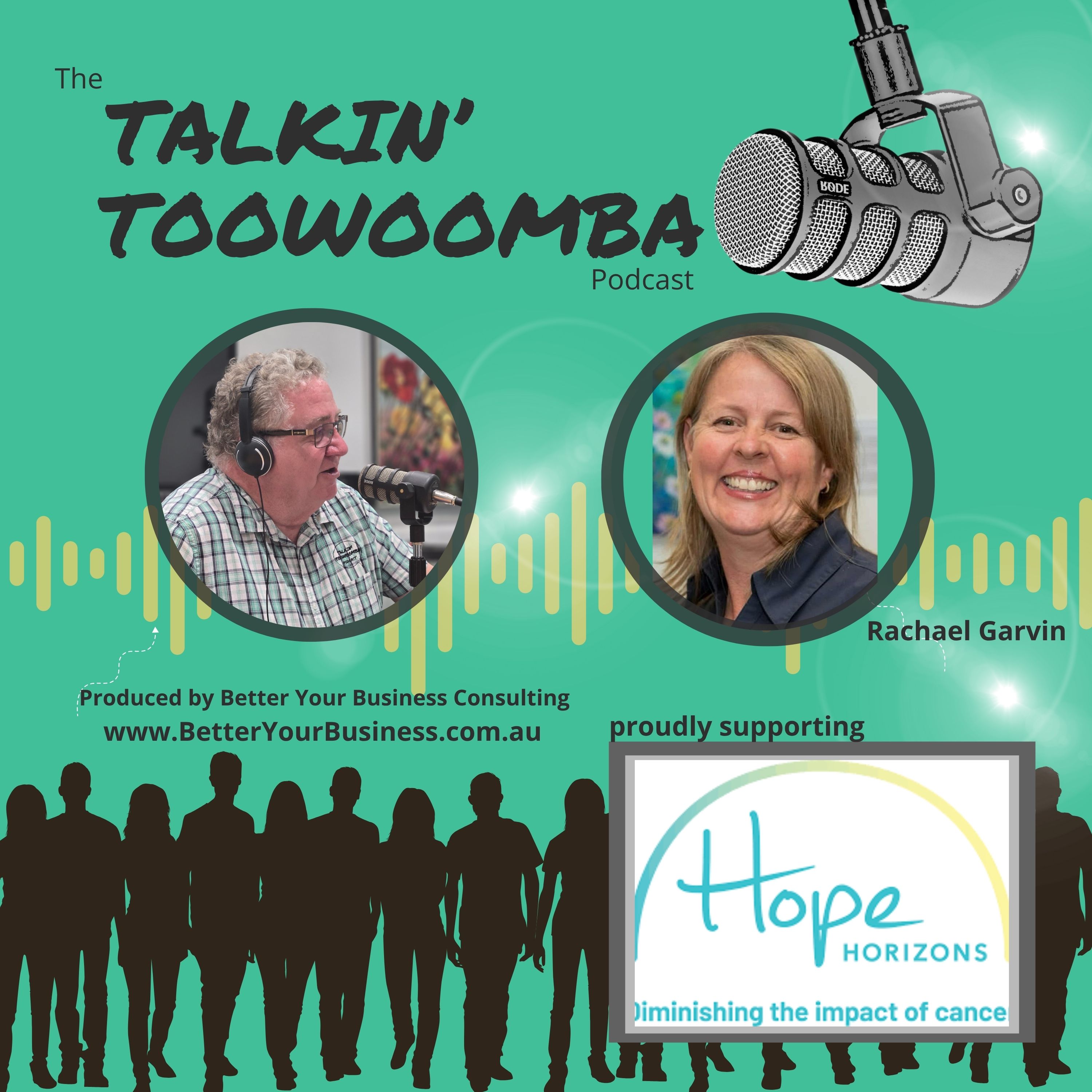
[00:00:05] Speaker A: Welcome to Talkin Toowoomba, the podcast sharing real stories that matter. We're proud to partner with Hope Horizons, shining a light on the journeys of locals impacted by cancer and the incredible people who walk beside them. Today's episode is brought to you by Betty or Business Consulting, helping local businesses grow with clarity and purpose.
Don't miss the upcoming Toowoomba Business accelerator event. Your chance to learn, connect, and take your business to the next level.
Now, let's get into today's conversation.
Today I'm chatting with Rachel Garvin, who's one of the many service providers here at Hope Horizons, and she specializes in helping people.
How you going, Rachel?
[00:00:53] Speaker B: How. I'm well, thank you. How are you?
[00:00:55] Speaker A: Yeah, good, thank you, Rachel.
Now, you, you do a couple of different things, I suppose, as, as your repertoire of skills.
One of the things is that you do what's called oncology massage. Now, we spoke briefly about this in another episode with Rachel Carter. Can you just fill us in a little bit about the oncology massage that you, you give to people like, like you give to myself, for example.
[00:01:27] Speaker B: Yeah.
[00:01:28] Speaker A: And, and, and what it is, what you're doing and how it helps.
[00:01:33] Speaker B: Yeah, certainly. So. Well, I've been a remedial massage therapist for 20 years, and I started down the line of oncology massage roughly six, six years ago, and I was looking for something that worked with the nervous system that actually, when we were listening to the client, we could give back to them a sense of normality and an understanding and letting them understand their body and having that time out. It's very particular, purposeful, slow moving, gentle massage, more in line with the nervous system than the muscular system.
Yeah. Really just to give that body some time out when they're going through quite a stressful period in their, in their time.
[00:02:32] Speaker A: Now, one of the other things I know you do, and it's part of a treatment for someone who's been through cancer surgery, they're scarring and that, that can be something almost as dramatic as the treatment for cancer itself.
So I'd like to have a bit of a chat about understanding what scar's about. So what exactly is a scar and how do they form?
[00:03:06] Speaker B: Yep. So this follows on from actually my oncology massage because I got to a stage where I could get someone to a certain stage, but there was still a restriction or there was still something that wasn't quite right. They'd have a burning or a sensation that they never felt was their normal.
And so I went down this scar therapy track and I have a fascination with scars, I suppose, but a healthy fascination. Healthy fascination.
I really want to know why. So a scar essentially is you've got a cut on your skin or an infection that you've ended up with. An open wound, burns, any of those kind of interruptions to your normal skin. Now, your normal skin is beautiful and pliable and soft and flexes.
Whereas scar tissue, when it comes in, it is made up mostly of a collagen based substance and it is not as flexible. And we have the most amazing body wear.
Everything works in like a webbing and it protects just under the layer of the skin.
And then you get these scars that come in and they're all crisscrossed and there's no real pattern, so they can become stuck.
And that's where scar therapy comes in.
[00:04:56] Speaker A: Okay, but there's something, there's more to be seen to a scar than just what's on the surface, isn't there? Is there more happening beneath the skin?
[00:05:05] Speaker B: Yes, yes, totally. So when you, you have a cut, say you may go through first of all the skin level, but you may go through the muscle.
If you're talking in the abdominal area, you're going to go through muscle and into all other areas. Now, all this has to knit back together inside.
So you may see a nice fine line on the outside, but inside it is a larger area that has or maybe become stuck. Not every scar becomes stuck, but sometimes they will, and it will keep growing sometimes and adhere to an internal organization.
And we try to soften all of that again so that you get a nice smooth area inside the abdominal cavity.
[00:06:03] Speaker A: Now, back in 22, I had surgery for prostate cancer and I had the robotic surgery. Okay. So I had fairly small scars.
And I'm going to put you on the spot. I'm going to ask you a question and you're either going to say yes, exactly, and explain it, or you're going to go, you're heading down the wrong track, Shane. And that's fine.
But after the surgery, because I didn't know about Hope Horizons and I didn't know about all the things that are available to someone who's going through a cancer journey, I just.
And with the help of my partner, I just went through and took care of myself the best I could post surgery.
But as a result of the surgery, I ended up getting a hernia, so I had to go back in for more surgery to have the hernia repaired.
You mentioned before about, like, when there's the surgery, you could more than just go through the skin layer. You might Go through muscle and that sort of thing.
If Ida had or had looked at possibly having some assistance with my scarring, could that have prevented my hernia or am I down the wrong train?
[00:07:26] Speaker B: We will never know.
That's the answer there.
[00:07:29] Speaker A: Fair call, Fair call.
[00:07:31] Speaker B: Yeah, it possibly could have because everyone thinks again the robotic and they're just tiny little holes, but they are scars so we must remember that. And it's a long, just a little hole, but it goes all the way through to where they're working.
That is something to always remember.
[00:07:55] Speaker A: And that's part of the reason why I brought it up because I know that you couldn't say, oh yeah, that definitely happened.
But to me it was having hear you talk about doing. Yeah, helping with the scale that could have helped, may not prevent it, but it might not have make it as bad as it was. I mean so yeah, yeah.
[00:08:15] Speaker B: Because inside like you've got the fascia now with that hole that went through all the fascia then also has to. But it's not a beautiful webbing that we all think of that our bodies make. It just sort of spirals itself and fills up that hole. So we've got to keep the fluid flowing through that to help the healing process. But also in saying that I've worked on a 23 year old scar and had changes as well. It doesn't have to be new scars.
[00:08:47] Speaker A: Okay.
Now many people don't realize that scars have emotional weight too.
Can you talk about the effects scarring can have on, on someone's confidence and well being in general?
[00:09:01] Speaker B: Yeah. So I, I find you've got to listen to the whole story.
And there are some people that wear their scars with pride and you know, this happened to me and this is what I have. And then there are others that look at themselves in the mirror and perhaps maybe they even see just a black hole. They don't even see anything there.
They may completely ignore their scar and never ever look at it or touch it.
So there's a definite trauma base to a scar that you also have to listen to.
When working with these scars.
[00:09:48] Speaker A: Do you find clients sometimes surprise the way a scar is impacting them?
[00:09:57] Speaker B: Yes, because all you see is that line on top of the skin.
Well, I didn't even understand until I got into it just how much is happening underneath. Like.
And I don't know how to describe this because we're going to, I'm hoping I'm going to describe it well. So if you grab with your right hand the bottom of your shirt and took a Great big hold of it and then gave it a twist, which I'm doing. Right?
[00:10:31] Speaker A: Yep.
[00:10:31] Speaker B: Now, where do you feel pulling?
[00:10:34] Speaker A: I actually feel it over on my left hand side, Right?
[00:10:37] Speaker B: Yep.
And then you can see.
And again I'm doing visual, but you can see pulling that comes from that area right across the front. And you're feeling it across the back as well.
[00:10:49] Speaker A: Yes, yeah.
[00:10:52] Speaker B: So that's just a bit of an.
[00:10:55] Speaker A: Idea for those listening.
Actually do that yourself because it's quite interesting because the moment I twisted my shirt, I was expecting to feel everything here where my hand is holding a certain twist and I suddenly thought, no, I can feel it over here. I can feel it across my back.
So yeah, yeah.
[00:11:15] Speaker B: So that's the impact. So, you know, say even a lumpectomy in a breast, people say, but I don't understand why the back of my shoulder's sore. Well, there's pulling. Everything happens.
[00:11:32] Speaker A: Okay. For those who've never heard of it, which I hadn't until we met, what exactly is scar therapy?
[00:11:42] Speaker B: So it is.
So what I do is a gentle scar therapy. And we're working with again, the nervous system, we're working with the lymphatic system and the scar itself. And it's just very little minute feather, like I describe it sometimes as patting a cat, nothing heavier than that. And we're trying to find those fascial pulls that we were just discussing there before with the T shirt twist and releasing all of those pools so that you can get yourself back down into a normal feel.
[00:12:26] Speaker A: Okay.
What type of scars benefit from this therapy?
Is it. Is there any. A few or is it.
[00:12:34] Speaker B: No. Every type of scar you'll find there's a scar will heal in different ways. So say you have, you know, a 5 centimeter scar down in the abdomen.
You'll. You'll see that the two ends are probably going to take a little bit longer to heal.
The middle might start to heal first and then. Then eventually you'll see what you're left with.
That's when. So roughly three months.
That's when I sort of come in and. Three months, I say with making sure there's no complications or anything else that goes with that.
And that's when I come in and I can start my work on it.
[00:13:20] Speaker A: So just, just reiterating there.
How soon after surgery or perhaps an injury that you've got and you've got scarring, can you start therapy and can it be helpful?
[00:13:32] Speaker B: Well, I like to know that the scar is completely healed.
[00:13:36] Speaker A: Yep.
[00:13:36] Speaker B: So that's the biggest Thing.
[00:13:39] Speaker A: Okay.
Why does. Do you think it's important that Hope Horizon has an experienced scar therapist like yourself on their team?
[00:13:49] Speaker B: Yeah, very important.
No, it's.
There is a real missing link that we find, and to give people back their mobility, to be able to look in the mirror and see themselves as themselves in their survivorship. They've got to see their new body and understand that this is them.
And.
And I think that's. That's a major benefit.
[00:14:25] Speaker A: Gonna put you a little bit on the spot.
[00:14:26] Speaker B: Okay.
[00:14:28] Speaker A: Without using their real name, is there someone that you've worked with with scar therapy and you saw a completely different person after they'd been through some therapy with you, to the person that walked in the first time they met you, not quite knowing what the scar therapy was all about and the impact that you were able to help and create for them?
[00:15:07] Speaker B: Yes.
I mean, I've got a few here, but.
Oh, yeah. So I have one client that I'll talk about, and she'll probably listen to this and giggle, but.
So her scarring, there were two different surgeries, and the two scars were impacting on each other. And what it had actually done was.
It sounds minute, but it's a big thing. Took away her belly button.
[00:15:44] Speaker A: Okay.
[00:15:45] Speaker B: It was all sucked in and tucked away, and she was like, you know, it's not me anymore. So we worked on it, and to see her come out giggling with tears in her eyes and say, I have my belly button back, I mean, that's just.
It makes a big difference to me and to them.
[00:16:09] Speaker A: Yeah.
I'm starting to feel a bit of emotional about it myself because I could. Yeah.
How long did it take?
How long was the therapy to. To create the change from her being able to say, I've got no belly button, to actually look. Got a belly button.
[00:16:32] Speaker B: So in the first session, we were able to make big changes, and pretty much we could find the belly button and. But I did do probably another four sessions after that just for it to remember that that's the way that it is and to keep that flow happening underneath the skin and stay hydrated and.
Yeah, that's probably. Yeah. So I probably did five sessions.
[00:17:01] Speaker A: If someone listening has a scar and they've struggled with this, what's the first step they can take to explore the therapy with HAP Horizons?
[00:17:10] Speaker B: Well, if they've had a cancer diagnosis, just walk through the door, come and talk to any of the volunteers here at the desk, and they will be able to get you.
[00:17:25] Speaker A: And I have a question that's come. Gonna be Completely left field for you.
I like doing that.
[00:17:32] Speaker B: I get that feeling.
[00:17:36] Speaker A: Okay.
You're a practitioner here. I stumbled over my own words. Then you're a practitioner here at Hope Horizons. Do you have your own business that you work in?
[00:17:48] Speaker B: Yeah. So I work out in Hampton. That's my clinic out there. Yep.
[00:17:54] Speaker A: So I suppose I could add to this conversation that if someone perhaps has.
[00:18:01] Speaker B: A scar that is not cancer related.
[00:18:04] Speaker A: It's not cancer related.
[00:18:05] Speaker B: Absolutely. Come and see me.
[00:18:07] Speaker A: They can get in contact with you and. And you could help them.
[00:18:10] Speaker B: Yep. Yep. And they can still contact Hope and Hope will give them my details. Yep.
In saying that as well, we have two other scar therapists on board and they are Toowoomba based.
So also if they don't want to travel out to Hampton, V from Golden Wattle Therapies is amazing. And Die down in Withcott is a wonderful practitioner as well.
[00:18:38] Speaker A: Thanks for that.
What's the one myth about scars you'd love to bust here today?
[00:18:45] Speaker B: You just gotta live with it.
That is just so wrong. And it's not just going to be what it is. We can make these changes and you will notice a big difference.
[00:19:03] Speaker A: Okay.
And finally, you're about to be let off the hook.
But not yet.
What do you hope people take away from hearing this? Our conversation today?
[00:19:18] Speaker B: That they can make their way in here, make big changes in their life and know that Hope Horizons has their back to help through their survivorship in any way we can.
[00:19:39] Speaker A: Rachel, thanks. That was great chat. Thanks for coming on the podcast.
[00:19:44] Speaker B: I'd say my pleasure, but I was rather nervous.
[00:19:47] Speaker A: But you got there.
[00:19:48] Speaker B: But I got there.
[00:19:49] Speaker A: You did.
Thanks for listening to Talking Toowoomba. If today's story inspired you, share it to help spread hope. Thanks to Betty of Business Consulting for their support and to Hope Horizons for their vital work.
Spots are limited for the Toowoomba business accelerator event. Check out the better your business Facebook page for details and secure your place.
Until next time, Keep talking Toowoomba SA.